
What does a healthcare SEO agency actually do?
A healthcare SEO agency makes a clinic or medical practice easy to find, and easy to trust, for people searching about the conditions it treats and the services it offers — on Google, in the map results, and increasingly inside AI-generated answers. The difference from general SEO is not the toolset. It is the standard the content is held to and the number of people who must agree before a page goes live.
Proposals for healthcare SEO services tend to list dozens of tasks. Underneath, the work falls into six workstreams. Use the right-hand column as a checklist when comparing vendors:
| Workstream | What you should receive | Warning sign if it is missing |
|---|---|---|
| Service-line keyword map | Every treatment and condition you want patients for, matched to the queries patients use, grouped by service line and location | A list of 20 broad keywords with no page assigned to each |
| Clinical content | One substantial page per treatment and per common concern, drafted with sources and reviewed by your clinician | “Four blogs a month” with no named author or reviewer |
| Technical SEO | Fast mobile pages, clean indexing, structured data, no duplicate or orphaned pages | No access to Search Console requested in week one |
| Local presence | An accurate Google Business Profile for each location, with services, hours, and categories that match the site | Profiles created in the agency's own account |
| Authority | Consistent listings on professional registers and directories, plus coverage earned on independent sites | Bulk link packages or paid guest posts |
| Measurement | Positions by service line, AI-search citations, enquiries, and the revenue line in your own records | Reports that count hours and posts but never revenue |
The same six apply whether the practice is a single dermatology clinic, a plastic surgery group, an IVF centre, or a private hospital — “hospital SEO” simply multiplies them by departments and locations. Dental search behaves differently enough to need its own playbook, covered in dental SEO agency. The page-by-page method behind each workstream is laid out in medical SEO; this page stays on choosing and contracting the agency.
Why is SEO for the healthcare industry held to a higher standard?
What does “Your Money or Your Life” mean for a clinic website?
Google's Search Quality Rater Guidelines single out topics where a poor page could harm someone's health, finances, or safety, and call them YMYL — Your Money or Your Life. Medical information is the textbook example. For those topics the guidelines ask raters to look harder at who wrote a page, what qualifies them, and whether the content agrees with established medical consensus. Raters do not set rankings directly, but the guidelines describe what Google's systems are built to reward.
How does E-E-A-T show up on an actual page?
E-E-A-T stands for experience, expertise, authoritativeness, and trust. On a clinic site it becomes concrete: a named author and a named medical reviewer with their qualifications; a visible “last reviewed” date; sources for anything factual, such as recovery times or risks; an About page with registration details; and practice information that matches everywhere it appears. None of this is decoration. It is the evidence a search system — and a cautious patient — looks for before trusting a health claim.
Where do general agencies usually go wrong?
Three failure patterns recur. Content written by generalist copywriters with no clinical check, which drifts into overstated outcomes. Device-maker claims copied word for word, which are both duplicate text and, often, advertising the regulator would not accept. And pages that never change once published, so a two-year-old price range or a withdrawn product name sits under your logo. A healthcare SEO company worth hiring has a written process for all three.
Who should medically review the content — the agency or your clinicians?
Your clinicians. The agency's job is to research, draft, source, and structure; the clinical judgement and the sign-off belong to a qualified person at your practice. That split protects patients, and it protects you, because in every one of our markets the professional responsibility for what appears under your name does not transfer to a marketing supplier.
| Market | Rules that shape the drafts | What the agency should build in |
|---|---|---|
| United States | FTC Endorsement Guides (2023 revision): claims must reflect typical results; agencies share liability for content they knew or should have known was misleading | Every outcome claim specific, sourced, and approved; no “results not typical” shortcuts |
| United Kingdom | GMC: doctors stay personally responsible for advertising made on their behalf; ASA/CAP: testimonials must be genuine and representative, no promised outcomes | Drafts prepared for the practitioner's sign-off, with cosmetic content kept free of time-limited offers |
| Australia | AHPRA: testimonials about clinical aspects cannot be used; cosmetic procedure guidelines in force from 2 September 2025; penalties up to AUD 60,000 for individuals and AUD 120,000 for bodies corporate | AHPRA-compliant pages by default: no testimonials, no outcome promises |
In practice the workflow we run has five steps: a brief built from patient questions; a sourced draft; an internal fact check against the sources; review and sign-off by your clinician; and publication with the reviewer's name and date on the page. Pages then go back for re-review when a guideline, price, or product changes. The clinician's time is the scarce input, so a good agency keeps drafts short enough to check properly and flags exactly which sentences need a medical eye.
What should a healthcare SEO contract say?
Most disputes with an SEO firm start in clauses nobody read closely. Four deserve attention before anything else: how long you are committed, who owns what, how results are verified, and what leaving costs. The table compares a common agency default with what to ask for.
| Clause | Common default | What to ask for | HEIM GLOBAL |
|---|---|---|---|
| Domain, Business Profile, analytics | Sometimes registered by the agency | Practice-owned from day one, agency as user | Stay in your accounts |
| Fee basis | Fixed retainer, plus ad spend | A basis tied to an outcome you can check | 30% of revenue from assigned lines |
| Verification | Agency-prepared report | Figures from your own systems | One monthly export from your CRM |
| Exclusivity | Often exclusive for search | Non-exclusive | Non-exclusive |
| Medical sign-off | Rarely written down | A named reviewer step before publishing | Your clinician approves every clinical page |
Two more lines are worth adding to any agreement: a list of the accounts and files handed over at exit, and a statement that the agency does not write, buy, or filter reviews. If a vendor resists either, that tells you how the relationship will end.
How do you choose a healthcare SEO company? Eight questions for the first call
Lists of “best medical SEO companies” are mostly written by the companies on them, often with the author's firm at the top. A short call with the right questions sorts the field faster:
- Who reviews the medicine? Ask for the named step, and who on your side signs off.
- Can I see a page you wrote for a practice in my specialty — with its sources and reviewer line?
- What do you measure every day? Rankings alone miss the AI answers patients now read first.
- Show me the tracker. A live dashboard beats a sample PDF.
- Whose accounts hold the domain, profiles, and analytics?
- What happens to the pages if we part ways?
- How is the fee calculated, and how do I verify it?
- Which rules do you write to — FTC, GMC and ASA/CAP, or AHPRA — and how does that change the copy?
Two answers should end the conversation: a dated promise of page one or of placement in ChatGPT, and an unwillingness to put ownership in writing. Nobody controls rankings or AI answers; what an honest agency offers is a method, measurement you can see, and terms that do not punish you for leaving.
What do healthcare SEO services cost — and what is the alternative?
Published pricing guides put healthcare marketing retainers at roughly $2,500–10,000 a month for an independent practice. Comprehensive programs covering SEO, paid search, and social typically run $3,000–8,000 for a single location and $10,000–25,000 for multi-location groups, while plastic surgery and med spa work often reaches $8,000–20,000 or more. Ad spend sits on top, and most agencies quote case by case rather than publishing a price.
We publish ours. $0 upfront — our fee is 30% of collected revenue from the patient lines you assign to us, CRM-verified, with no per-patient counting. Content production, clinician-ready drafts, hosting, tracking, and the 24/7 multilingual response line are funded by us. Which lines you assign and what the base excludes — usually existing patients and channels you run yourself — are designed around your practice during the free audit, before anything is signed.
The obvious question, and a fair one: is this a fee for each patient? No. Pay-per-lead vendors earned their poor reputation by billing for enquiries that never booked. We never count, steer, or broker individual patients; the 30% is a flat marketing-services rate on a revenue pool, read from your records. In the US the model covers cash-pay and self-pay services and excludes federal-program business, and practices in states with strict fee-splitting rules can take a flat-tier alternative. The three terms that always travel with it: $0 upfront · non-exclusive · monthly CRM settlement. Retainer benchmarks in more detail are in healthcare marketing agency cost, and the reasoning behind percentage pricing in performance-based healthcare marketing.
What evidence should a healthcare SEO agency be able to show?
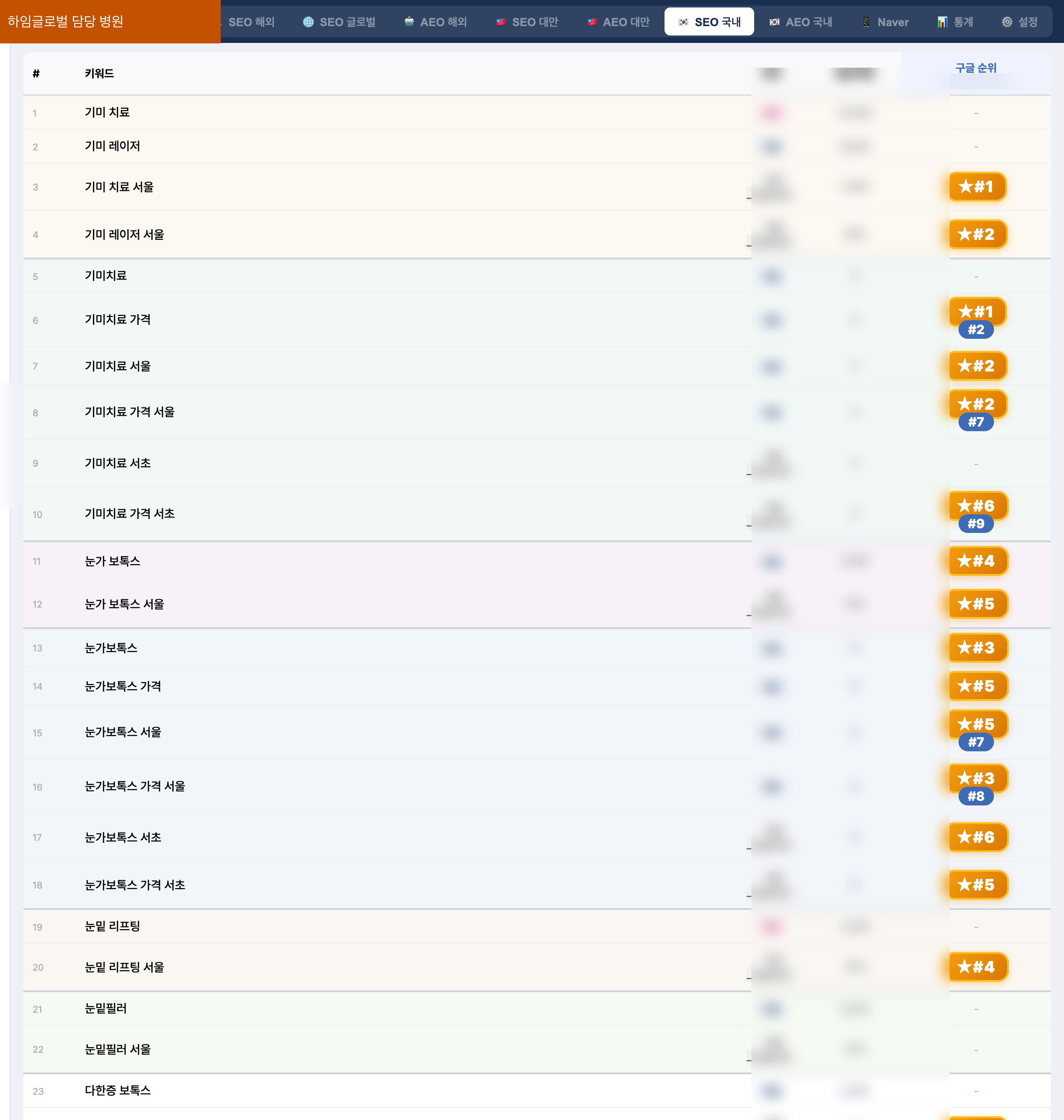
Screens from real accounts, not case-study prose. Ours come from Seoul, where clinics market in five languages to two million international patients a year. The first screen is a rank board for one client's domestic keywords: each row is a treatment or concern query, and the stars mark where the client's own pages sit on Google.
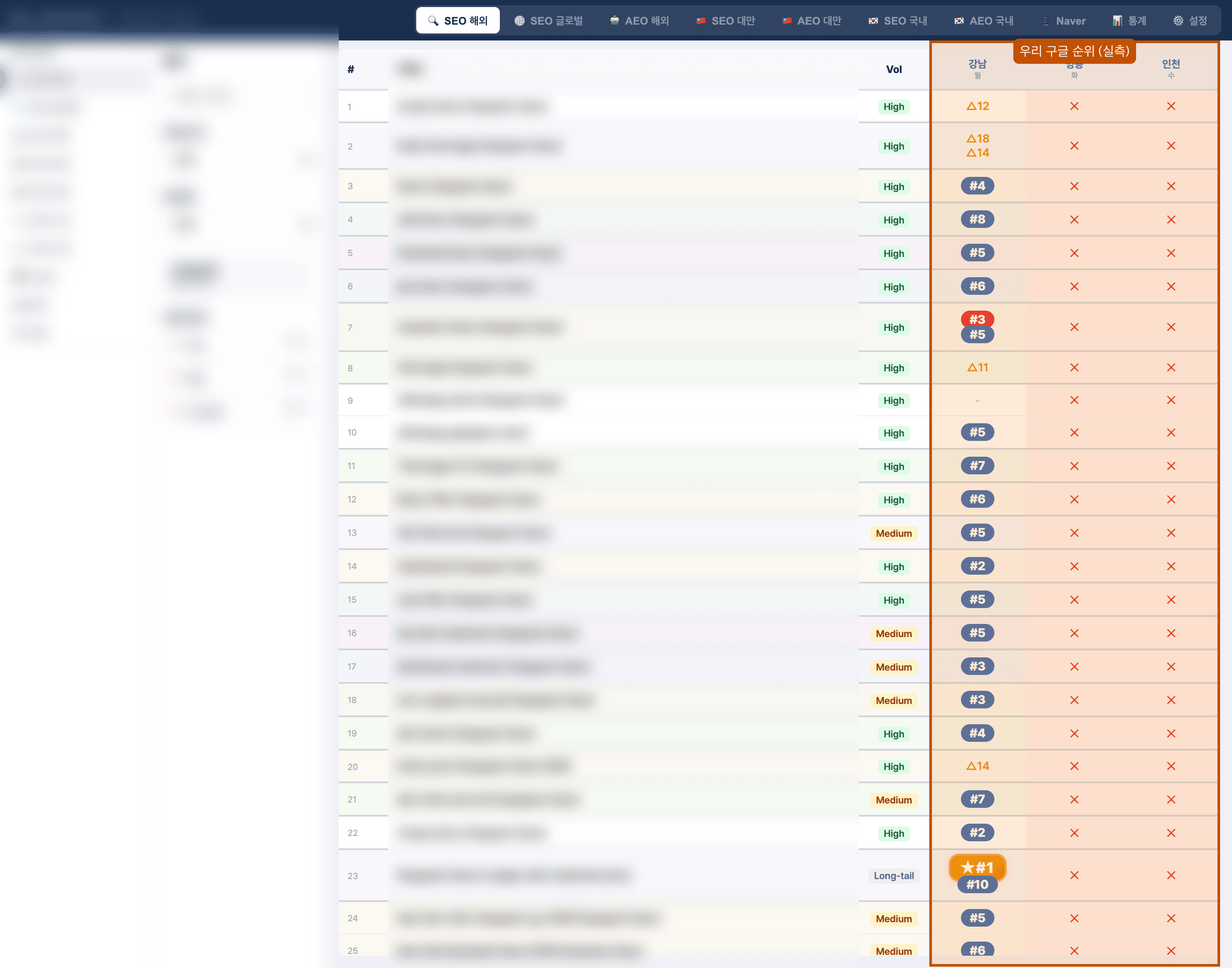
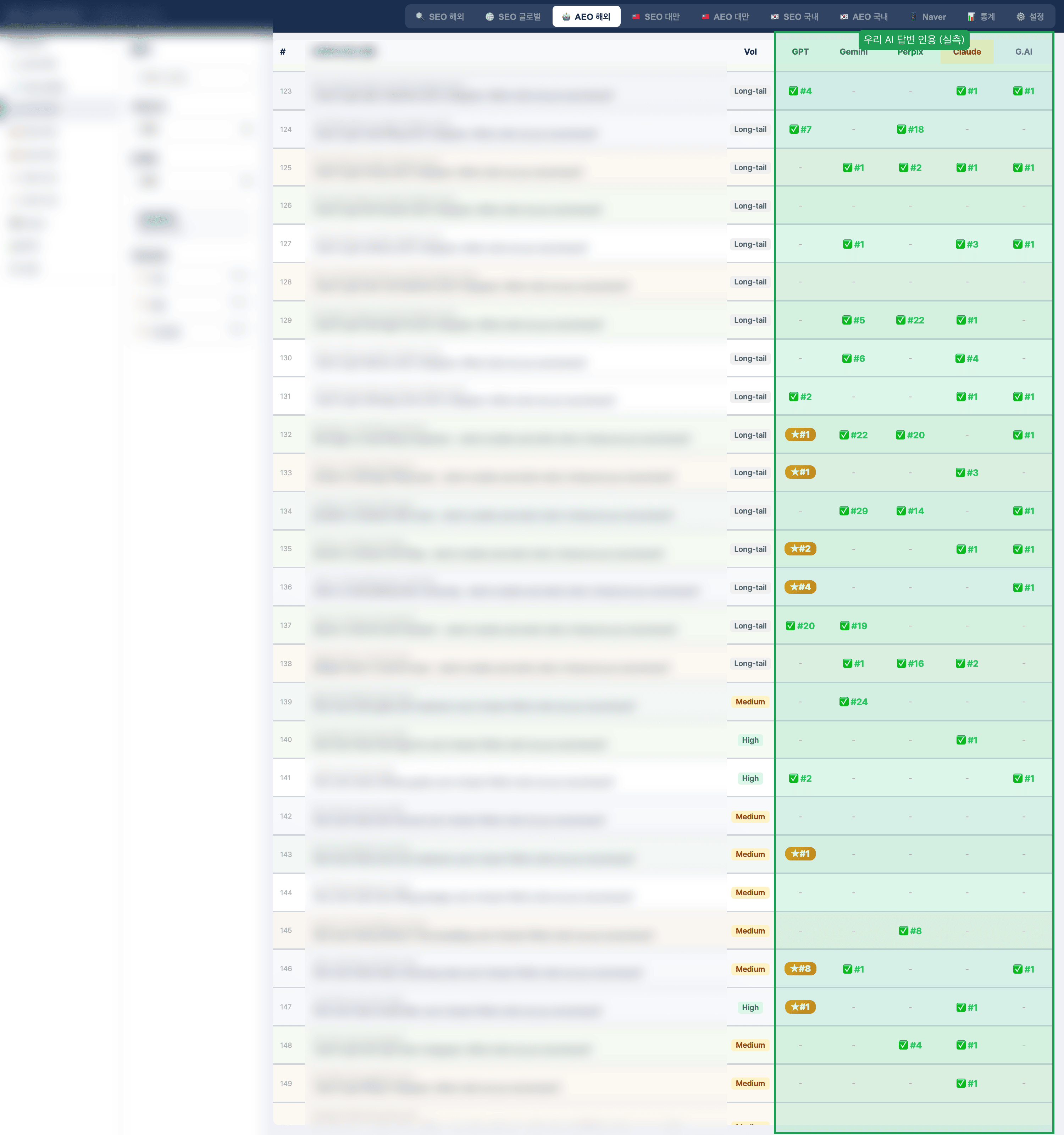
The same discipline runs on English keywords and across AI engines. Both trackers below update automatically every day, and they are what you see on the audit call — live, not as screenshots.
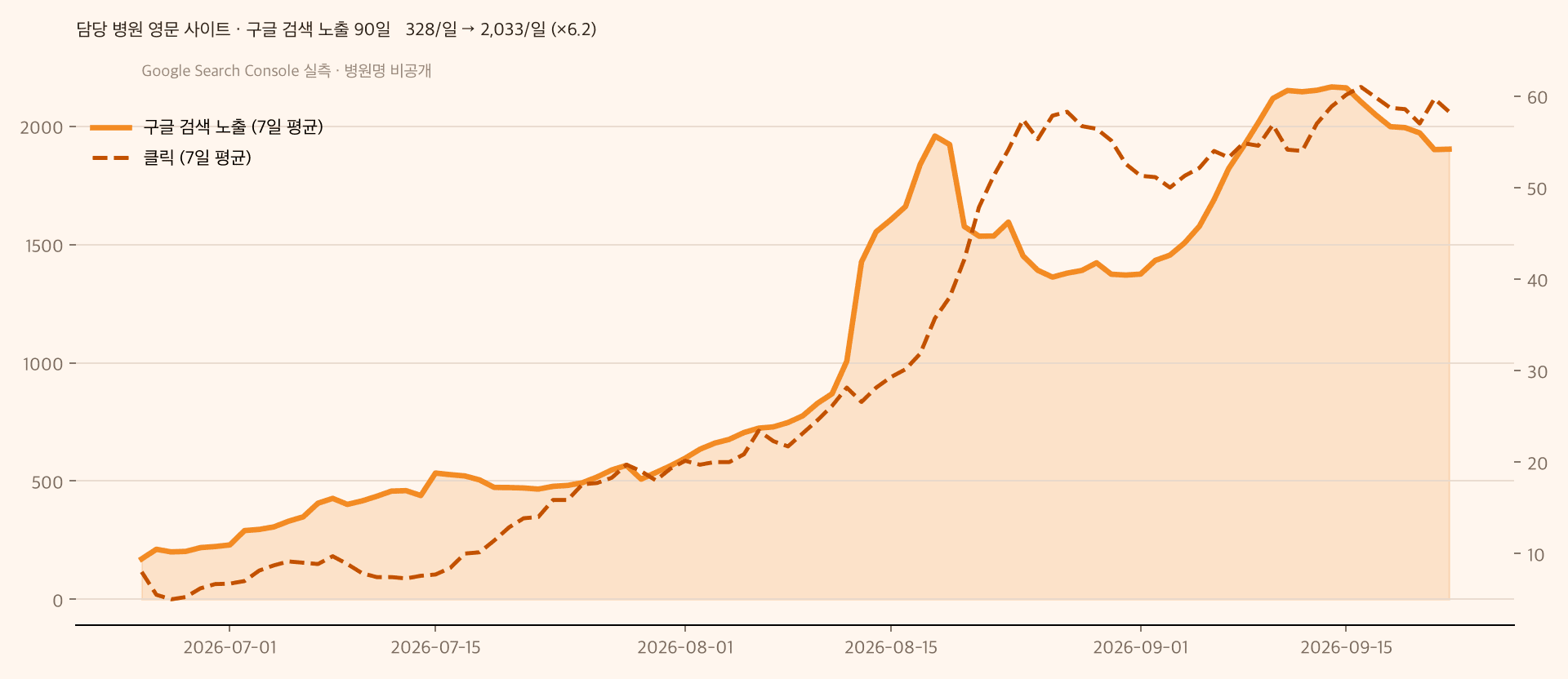
At revenue level, two Seoul dermatology clinics grew foreign-patient revenue in the language lines we managed by +200% and +186%.1 Neither is in your market, and we say so; what transfers is the method — reviewed pages per service line, consistent practice data, and daily measurement of both Google and AI answers.
1 Basis: each clinic's own CRM — revenue from foreign patients in the language lines assigned to us, compared with the clinic's earlier baseline. Results vary by specialty, city, and competition; individual results vary. Names are withheld under NDA, and the dashboards are shown full screen on the call.
Should healthcare SEO target local patients or patients from further away?
Local patients first. Most people searching for a dermatologist, a fertility clinic, or a health check are within travelling distance, and that domestic flow is the base any engagement has to secure. Beyond it sits the upside: around 68 million Latinos in the US, many searching in Spanish; Chinese-speaking communities in Sydney and Melbourne; and more than 100,000 overseas patients treated in London each year. Pages written natively in those languages reach searches an English-only competitor never enters. When the base works, those lines are added on the same foundations; medical tourism SEO covers the international side.
What happens in the first month with a healthcare SEO agency?
With us, it starts with the free AI-visibility audit: where your practice appears for its main services on Google, in the map results, and in answers from ChatGPT, Gemini, and Google's AI Overviews, plus the gaps in your service-line pages. If the numbers justify it, we agree the assigned lines, the base, and your clinician's review step, then build. Launch takes about 30 days from the audit. Positions tend to move within weeks and settle over months, depending on competition. You see the same dashboards we do from day one; if the work produces no revenue in your CRM, 30% of nothing is nothing.
'/%3E%3C/svg%3E)