What is medical tourism SEO — and who is this page actually for?
Medical tourism SEO is the practice of making a clinic findable and choosable by patients who research care across borders and languages: search rankings in the languages patients actually type, content that answers the questions they actually ask, and — since AI answers started absorbing the top of the funnel — citations inside ChatGPT, Gemini, Google's AI Overviews, and Perplexity.
One clarification before anything else, because the search results for this keyword are genuinely confusing: most content published under "medical tourism SEO" is written for hospital groups in destination markets — Thailand, Turkey, Mexico — competing for outbound Western patients. This guide is written for the other side of the table: owners and practice managers of clinics in the US, UK, and Australia. The receiving side. That includes London self-pay clinics with genuine Gulf inbound, gateway-city US dental practices, Australian IVF clinics with Southeast Asian demand — and, just as much, practices with no international ambitions at all who simply want the same multilingual search machinery pointed at the communities around them.
That dual use is the point. The pages that make a patient in Riyadh choose a London clinic are built with the same craft as the pages that make a patient three suburbs away choose yours: real answers, real evidence, structure a machine can parse. If a vendor tells you domestic and international search are two separate projects with two separate budgets, they are selling you the same engine twice. For the category-level question — facilitator versus retainer agency versus performance partner — see our international patient marketing agency guide; this page stays on the craft.
How is it different from the SEO you already have?
Local SEO optimizes one language, one map pin, one radius. Medical tourism SEO changes three variables at once, and each one changes the work.
First, the query space is different. A domestic patient searches "dermatologist near me." A cross-border or cross-language patient runs a research project: treatment names in their own language, your city as a destination, price comparisons, safety and credential checks, and "which clinic" questions — often across a dozen sessions before first contact. A page per query type, per language, is not over-engineering; it is the minimum shape of the demand. Our own asset base — 7,700+ pages across five languages — exists because that is what the query space actually looks like when you map it honestly.
Second, translation is not localization. A machine-translated services page ranks for almost nothing, because patients in each language use different words, different platforms, and different trust signals. Spanish-speaking dental patients in the US search differently than Gulf patients researching London. The keyword map has to be built natively per language — which is why we build one before a single page is written.
Third, the conversion path is different. International and community-language patients do not phone during your office hours. They message — WhatsApp, LINE, WeChat — at 2 a.m. your time. SEO that ends at a contact form leaks most of what it wins; the response layer is part of the search product, which is why our engagements include a 24/7 multilingual response line rather than treating it as someone else's problem.
The five working parts of a medical tourism SEO build
Stripped of vendor language, every serious build has the same five parts. This is the checklist we run — and the one to hold any vendor against.
| Part | What it is | What "done properly" looks like |
|---|---|---|
| 1. Language-market selection | Deciding which languages earn a build at all | Follow the patients, not the atlas: Arabic for London self-pay, Spanish for US gateway cities, Chinese for Sydney and Melbourne — validated with search-volume data before writing |
| 2. Per-language keyword map | The native query inventory: treatment × city × question | Built by native research, not translated from English; every page traces to a mapped query |
| 3. Patient-question pages | Long-form pages that answer one real question each | Answer-first structure, evidence, FAQ blocks — written to your market's advertising rules (AHPRA 2025, GMC/ASA CAP, FTC) |
| 4. Machine-readable structure | Schema markup, hreflang, clean architecture | Every page parseable by search and AI engines alike; languages correctly cross-referenced |
| 5. Corroboration & measurement | Signals that verify you + tracking that verifies us | Google Business Profile and review signals aligned; live rank tracking on every mapped keyword and daily AI-citation checks — visible to you, not a monthly PDF |
Two of these parts fail most often. Part 2 fails silently — agencies translate an English keyword list and wonder why the pages never rank. Part 5 fails loudly, a year later — no live tracking means no way to know whether anything worked until the contract is already renewed. Ask to see the tracking dashboard on the sales call, not after signing.
AI search moved the finish line — rankings alone no longer close the loop
The reason this guide keeps mentioning AI engines in an SEO article: the finish line moved. Gartner projects traditional search engine volume to fall 25% by 2026 as users shift to AI assistants, and patient behavior is already there — "which clinic should I book" is now a question typed into ChatGPT and answered by Google's AI Overview before a results page is ever scrolled.
The good news for anyone doing SEO properly: the substrate is the same. AI engines cite pages that rank, answer questions directly, and carry verifiable evidence. The work that wins a Google position is the work that earns an AI citation — extended with answer-first structure, schema, and third-party corroboration. The practical consequence is a measurement change: we track live Google positions on 2,050 keywords and run daily citation checks across four AI engines, because a clinic can hold organic #1 and still be invisible in the answer layer where patients increasingly decide. If that describes your practice, we wrote a separate diagnostic for it: why your clinic isn't showing in AI search — and a deeper method piece on AI search optimization for clinics.
For clinics choosing where to invest first, the honest sequencing is: the content asset base serves both layers, so build it once, measure it twice. A dedicated healthcare AEO capability is not a replacement for SEO — it is what SEO reports to now.
What should medical tourism SEO cost?
Benchmarks first, so the model that follows has context. Standalone dental SEO runs $750–5,000 a month (most commonly $1,000–2,500). Full healthcare marketing retainers run $3,000–8,000 a month for a single location — billed whether results arrive or not, with ad spend on top. Multilingual scope multiplies those numbers, because every language line is its own keyword map and content stream.
Our model replaces the retainer entirely: $0 upfront — our fee is 20% of revenue from the patient lines you assign to us, CRM-verified, with no per-patient counting. Content production, domains, hosting, rank and AI-citation tracking, and the 24/7 multilingual response line are funded by us. The exact base is designed around your practice during the free audit, before anything is signed — which lines you assign (domestic, international, or both), what counts, and what is excluded automatically: existing patients, channels you run yourself, and any federal-program business in the US.
Four structural terms always travel with the 20%: $0 upfront · non-exclusive · cancel anytime · monthly CRM settlement. And the legal line, stated plainly: this is not a payment for sending patients. We never count, steer, or broker individual patients — the 20% is a flat marketing-services rate on a revenue pool we are responsible for growing, verified in your own CRM. Have your healthcare attorney review the agreement; we expect it.
| Term | How it works |
|---|---|
| Rate | 20% flat — five new patients or five hundred, the rate never moves |
| Base | Collected revenue from the patient lines you assign — designed with you during the free audit |
| Verification | Your CRM — one monthly export, no per-patient counting, no receipts |
| Upfront cost | $0 — no retainer, no setup fee |
| Exclusivity | None — keep your current agency, run your own ads |
| Cancellation | Anytime — no lock-in, no termination fee; the coverage and links built stay with your clinic |
Where was this playbook proven?
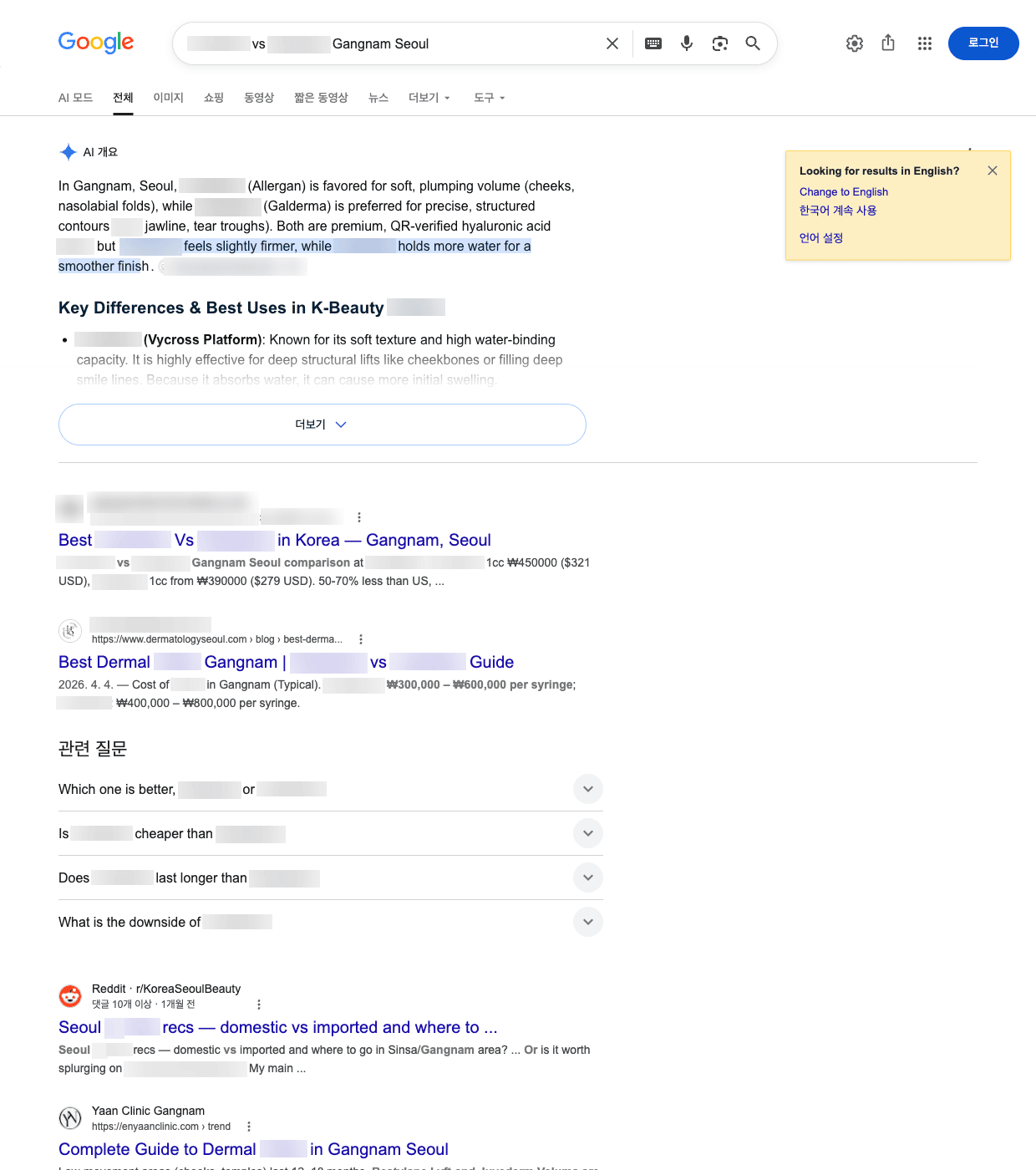
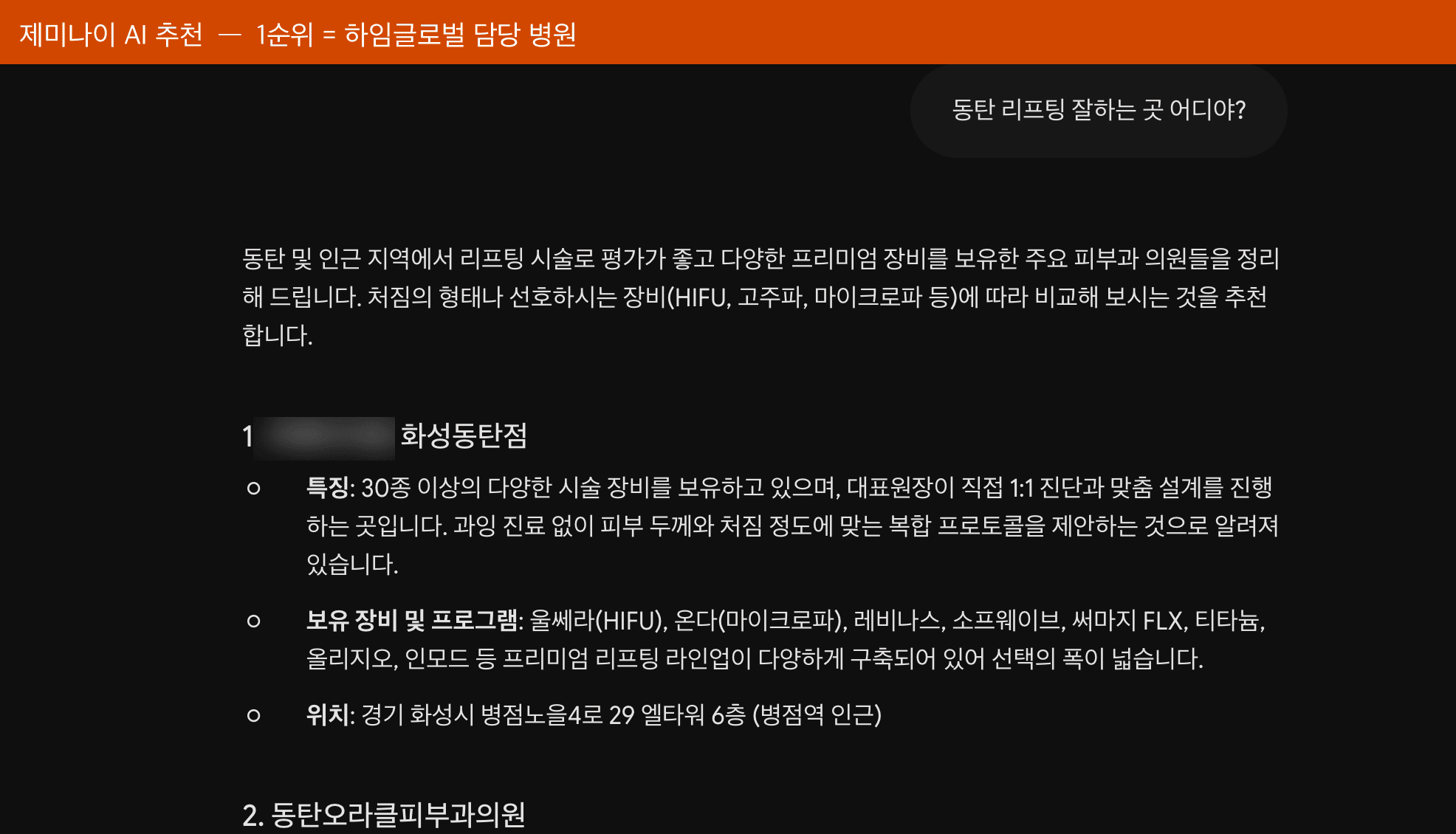
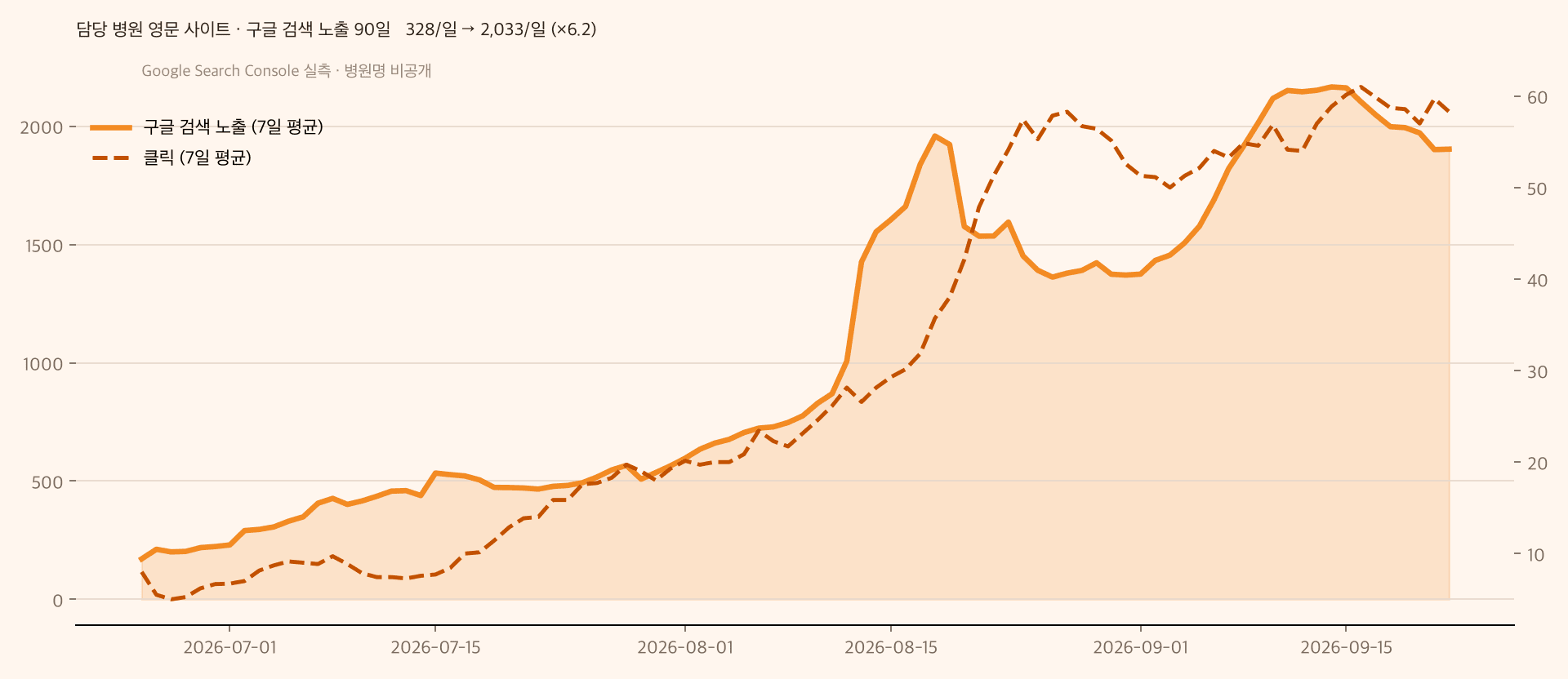
Seoul — the world's most competitive medical tourism market. Korea treated 2.01 million international patients in 2025 (Ministry of Health and Welfare), and medical marketing there is fought in five languages simultaneously. Ranking in that market, and being cited by AI in that market, is the credential behind every claim on this page. Two documented cases, both dermatology clinics, both measured the same way:
How to start — whether or not you start with us
If you take one action from this page, take this one: find out where you stand before you buy anything. Ask ChatGPT and Gemini the questions your patients ask — "best-reviewed [your specialty] in [your city]," in English and in the second language of your patient base — and search your core treatments the way an out-of-area patient would. Most owners have never seen their clinic through that lens; the result usually settles the "do we need this" debate in one sitting.
If you want that done rigorously, that is exactly what the free AI-visibility audit is: your clinic's live standing across Google, ChatGPT, and Gemini, the language markets that actually search for your specialty in your city, and — if the numbers justify it — how the 20% model would map to your practice. If they don't justify it, the audit says so; a model that only earns on results has no incentive to sign a market it can't move. Clinics thinking beyond SEO — toward the full international patient operation — can start from the honest playbook on attracting international patients or the international patient department outsourcing guide instead.
'/%3E%3C/svg%3E)