Why is plastic surgery marketing different from marketing a general practice?
Three things set it apart. The fee is large and almost always self-funded, so the patient carries the full financial risk. The result is visible on their face or body for years, so the choice of surgeon feels personal and permanent. And the decision is slow: patients often research for months before they book a consultation, then compare two or three practices before they commit. Marketing for plastic surgeons that only chases clicks spends money at the one moment the patient is least ready.
The useful way to plan it is by stage. At each one the patient asks a different question, and the practice either answers it on its own pages or leaves the answer to a forum, a review site, or a competitor.
| Stage | What the patient searches or asks AI | The page that should answer it |
|---|---|---|
| Exploring | “Is a mini facelift worth it at 50?” · “breast reduction recovery time” | A procedure page that explains candidacy, steps, and recovery in plain language |
| Comparing techniques | “deep plane vs SMAS facelift” · “fat transfer or implants” | An honest comparison page, written or reviewed by the surgeon |
| Choosing a surgeon | “board-certified rhinoplasty surgeon near me” · “who does revision rhinoplasty in Sydney” | A surgeon page with training, memberships, and the procedures they actually focus on |
| Checking cost | “tummy tuck cost London” · “what’s included in the price” | A price-range page that lists what is and is not included |
| Booking | “what happens at a first consultation” | A consultation page with a short, clear booking path |
Most practice websites cover the first and last rows and skip the middle three — which is exactly where patients decide between you and the practice down the road.
What does plastic surgery SEO need that general medical SEO does not?
One deep page per procedure, not one page per category
“Facial surgery” is not what patients type. They type the procedure: blepharoplasty, rhinoplasty, neck lift, breast augmentation, abdominoplasty. Plastic surgery SEO services worth paying for build a substantial page for each one you offer, covering who it suits and who it does not, what happens on the day, a realistic recovery timeline, risks stated plainly, and a price range. Thin pages with a stock photo and a booking button rank poorly and are rarely quoted by AI engines.
Surgeon pages that make credentials checkable
In this specialty the surgeon is the brand. A dedicated page per surgeon — qualifications, registration, society memberships, the procedures they focus on, published work — gives search engines and AI assistants a clear entity to connect to your practice. It also answers the question patients ask most: who will actually operate on me? SEO for plastic surgeons that skips this step leaves the practice anonymous at the moment trust matters most.
Local SEO for plastic surgeons
Even a surgeon with a national reputation gets most consultations from within driving distance. That means a complete Google Business Profile with each procedure listed as a service, consistent practice details across directories, and a review profile built through your own intake process. Location pages should exist only where you actually see patients; dozens of near-identical suburb pages are treated as doorway pages.
Surgical and non-surgical lines kept apart
Many practices offer injectables and skin treatments alongside surgery. Cosmetic surgery SEO works better when surgical and non-surgical pages are clearly separated: the audiences differ, the price points differ, and in Australia the 2025 guidelines treat higher-risk non-surgical procedures as their own category. Mixing them on one page blurs both.
What can a practice publish — before-and-after photos, reviews, offers — in the US, UK, and Australia?
This is the part of plastic surgery advertising that varies most between markets, and the one where the professional responsibility stays with you, not the agency. The summary below is for orientation, not legal advice; every page we write is approved by you before it goes live.
US — FTC Endorsement Guides
- Results shown in photos or testimonials are read as what patients can typically expect; a “results not typical” line does not fix a misleading impression
- Agencies that create or spread content they knew, or should have known, was misleading share the liability
- Keep galleries representative, consented, and free of retouching that changes the outcome
UK — ASA/CAP and GMC
- Testimonials must be genuine and representative, and outcomes cannot be promised or exaggerated
- Cosmetic surgery advertising cannot trivialize surgery, use time-limited offers, or target under-18s
- The GMC keeps responsibility for advertising with the doctor, even when an agency writes it
AU — AHPRA 2025 cosmetic guidelines
- Testimonials about clinical aspects cannot be used — liking, sharing, or linking to them included
- Before-and-after images are only conditionally allowed: not misleading, with consent, and further limited for higher-risk procedures
- No advertising aimed at under-18s; penalties reach AUD 60,000 for individuals and AUD 120,000 for companies
In practice this changes how pages persuade. A UK or US page can carry a representative gallery with clear context; an Australian page carries none of the testimonial material and leans on procedure detail, surgeon credentials, and the consultation process instead. The full Australian picture, including what changed on 2 September 2025, is set out in AHPRA-compliant clinic marketing.
Where do plastic surgery PPC and paid social fit?
Paid search and paid social can fill a consultation calendar quickly, and many practices should keep them. Their limit is that the traffic stops the day the budget does, and clicks in this category are expensive because every competing practice bids on the same procedure terms. Ad platforms also review health-related ads more closely when procedure names appear in the ad text, which slows launches and narrows what copy can say.
The pages described above are what make paid traffic convert: a visitor who lands on a thin page leaves, while one who lands on a full procedure page with a named surgeon and a clear consultation path stays in the research cycle with you. Our engagement is non-exclusive, so your current ad agency and in-house campaigns carry on unchanged; the 30% applies only to revenue in the lines assigned to us.
How do ChatGPT and Gemini change the way patients shortlist a surgeon?
Patients now ask an assistant the questions they used to type into five separate searches: “Which surgeons in Miami are known for revision rhinoplasty, and roughly what does it cost?” The answer is a short list of names, pulled from procedure pages, surgeon pages, directories, and press coverage. A practice that is absent from that list never enters the comparison, however well it ranks for a single keyword.

We check those answers every day rather than inferring them from rankings. The log below records, question by question, which of four AI engines name the client clinic.
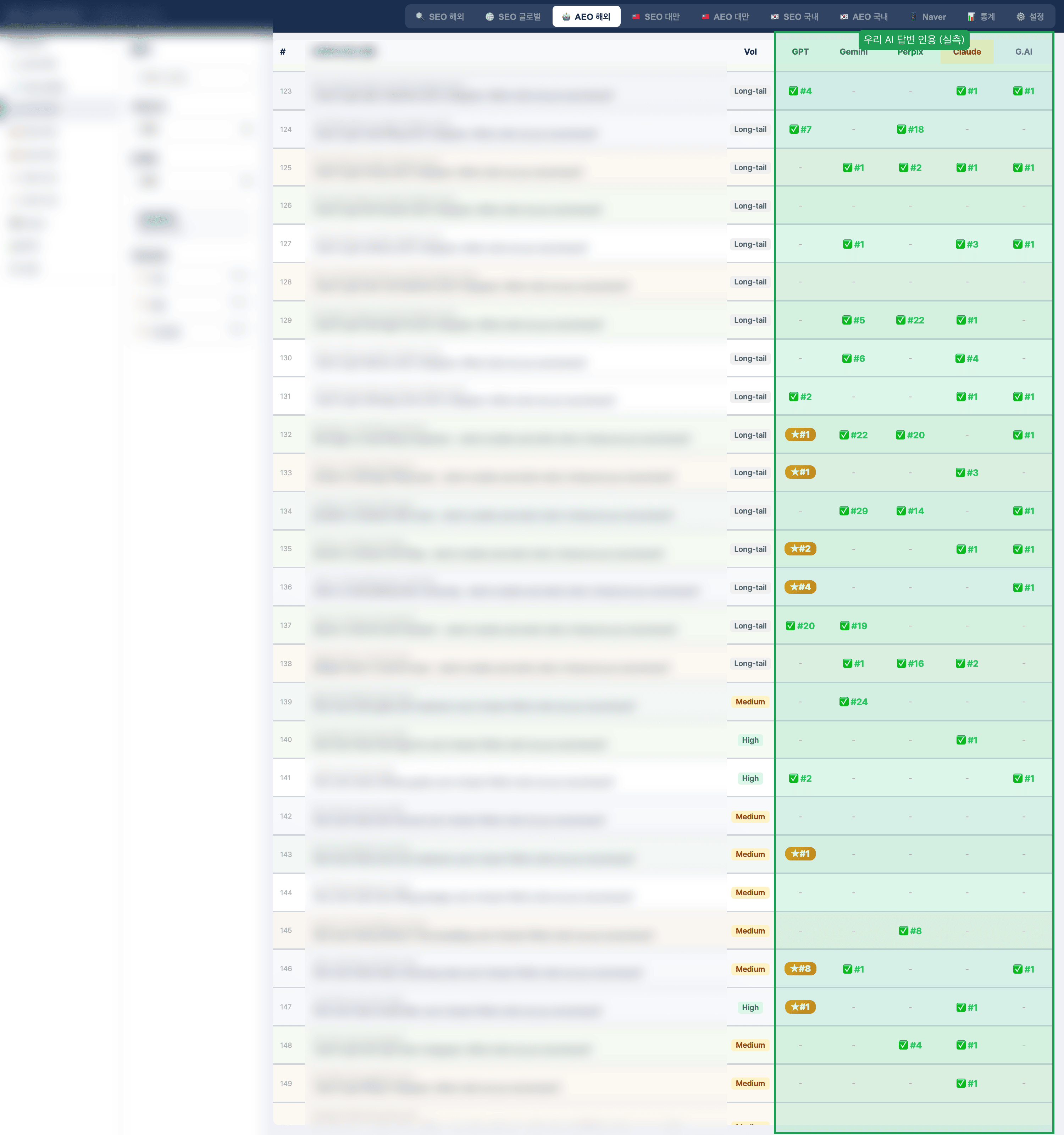
The mechanics of how engines pick names are covered in how AI decides which clinics to recommend.
Should a cosmetic surgery practice market to local or international patients?
Local first. Most plastic surgery consultations come from patients who can attend follow-up appointments easily, and that local flow is the base of every engagement we take on. Two forces push beyond it.
Outbound leakage. Patients in all three markets now price surgery abroad: Americans travel to Mexico and Turkey, and Australia’s “cosmetic surgery holiday” to Thailand or Turkey is a public talking point. A practice cannot win on price alone, but pages that answer the questions those patients research — revision rates, aftercare, what happens if something goes wrong far from home — keep part of that flow local.
Inbound upside. It is real, but specific. London treats more than 100,000 overseas patients a year, many from the Gulf. Australia’s inbound strengths include aesthetic and reconstructive surgery, with patients from Southeast Asia and the Pacific. In the US, the South accounts for about 31% of inbound medical travel, which favors gateway cities with Spanish-speaking patients. Each of these patients researches in their own language, which is why we write native pages rather than translated ones. London practices can read attracting Gulf patients to London; the language side is covered in multilingual patient acquisition.
What does plastic surgery marketing cost — a retainer, or 30% of results?
Plastic surgery and med spa sit at the top of healthcare agency pricing: published guides put retainers in these categories at $8,000–20,000+ a month, before any ad spend. The invoice is the same in a month when consultations fall.
We remove that fixed line. $0 upfront — the fee is a flat 30% of collected revenue in the patient lines you assign, CRM-verified, with no per-patient counting. We fund the procedure and surgeon pages, the multilingual hub we operate for your practice, tracking, and the 24/7 multilingual inquiry response. Which lines you assign and what the base excludes — typically existing patients and channels you run yourself — are designed around your practice during the free audit.
| Line item | Typical plastic surgery agency | HEIM GLOBAL |
|---|---|---|
| Monthly fee | $8,000–20,000+ retainer, ad spend on top | $0 — 30% of revenue from assigned lines |
| A slow month | Same invoice | The fee falls with the revenue |
| Procedure and surgeon pages | Often a set number of blog posts | One page per procedure and per surgeon, in each language you serve |
| Photo and review compliance | Left to the practice | Written to FTC, ASA/CAP, or AHPRA rules; you approve every page |
| AI-search measurement | Add-on, if offered | Daily citation checks across four AI engines |
| Contract | Commonly 12 months | Non-exclusive |
The 30% is not a payment for patients. We never count, steer, or broker individual patients; it is a flat marketing-services rate on a revenue pool, read from your own records. It applies to cash-pay and self-pay work only, and practices in states with stricter fee-splitting rules, such as Florida, New York, and California, can choose a flat-tier alternative. Three terms always travel with it: $0 upfront · non-exclusive · monthly CRM settlement. Have your healthcare attorney read the agreement. Wider benchmarks are in healthcare marketing agency cost.
What evidence is there that this approach works?
Our record was built in Seoul, one of the most competitive aesthetic markets in the world, where clinics market in several languages at once and more than two million international patients arrived in 2025. At two dermatology clinics there, foreign-patient revenue rose +200% and +186% in the language lines we ran.1 They are aesthetic dermatology practices, not surgical ones; what carries over is the method — procedure-level pages, consistent entity data, and daily measurement of rankings and AI answers.
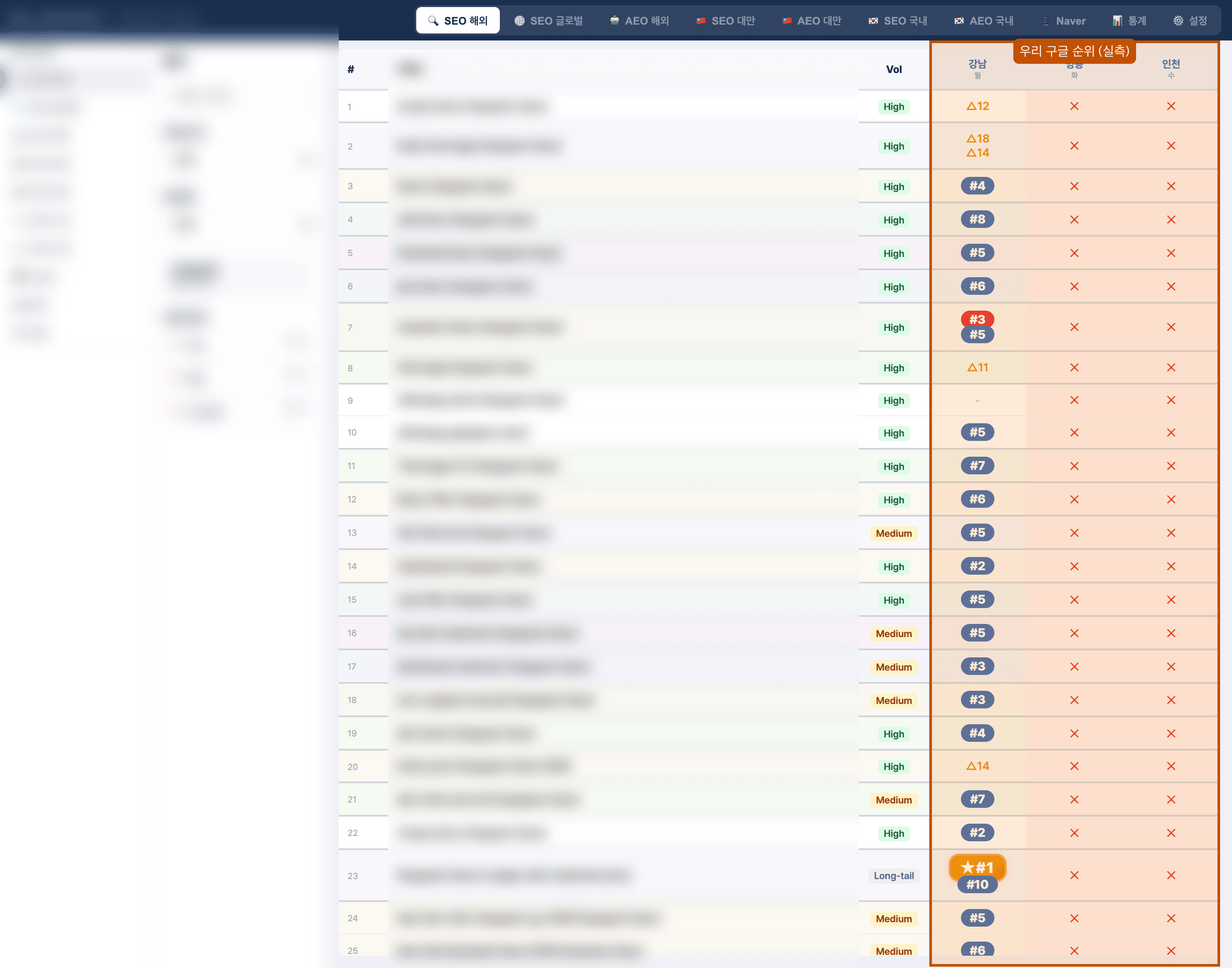
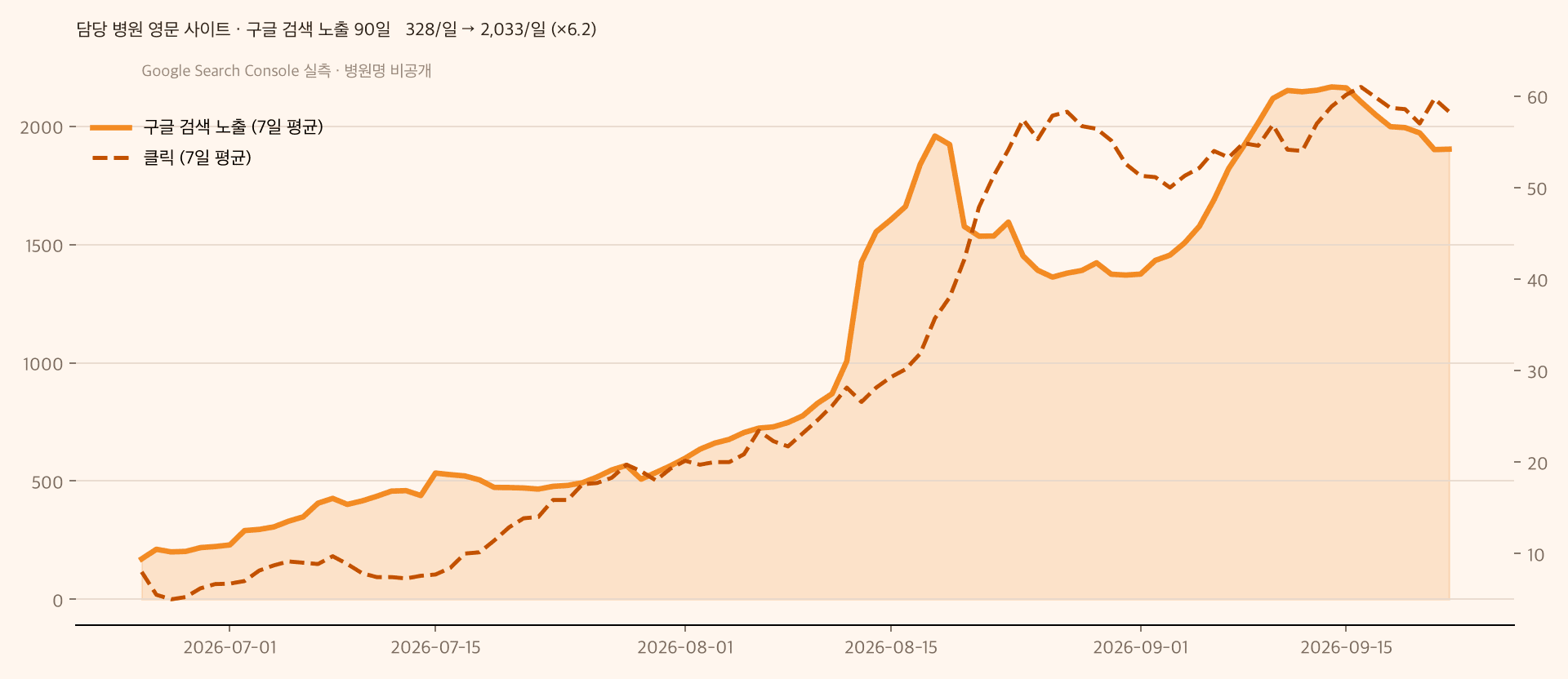
1 Internal CRM data, two Seoul dermatology clinics — foreign-patient revenue in assigned language lines against the prior baseline; individual results vary with specialty, location, and competition. Clinic names withheld under NDA; a full-screen walkthrough of the live dashboards is available on the call.
What should you ask a plastic surgery marketing agency before signing?
Where do the gallery images come from? Stock or borrowed before-and-after photos are misleading in every market and a regulatory problem in Australia. Who signs off on copy? If the answer is not “the surgeon, every page,” the agency is putting your registration at risk. Does the proposal promise consultations or a ranking by a date? Nobody controls either; a dated promise is a sales tactic.
Who holds the Google Business Profile and the domain? Both should be in the practice’s name from day one. How are reviews gathered? They should come from your own patients through your own process — never written, bought, or filtered. How is attribution settled? If it depends on the agency’s tracking numbers, expect disputes; one export from your own CRM leaves nothing to argue about. The free AI-visibility audit is a fair way to test any agency, us included: it shows where your practice appears today across Google, ChatGPT, and Gemini.
How does an engagement start?
With the audit: what four AI engines say when asked about your procedures in your city, where your procedure and surgeon pages rank, which research-stage questions have no page at all, and which market rules apply to your copy. If there is room to grow, we agree which patient lines you assign and what the base excludes, then build. Launch takes about 30 days from the audit; rankings and AI citations usually begin moving within weeks and build over several months, depending on how crowded your city is. You see the same dashboards we do from the first day.
'/%3E%3C/svg%3E)