
What actually happens when a patient asks AI for a clinic?
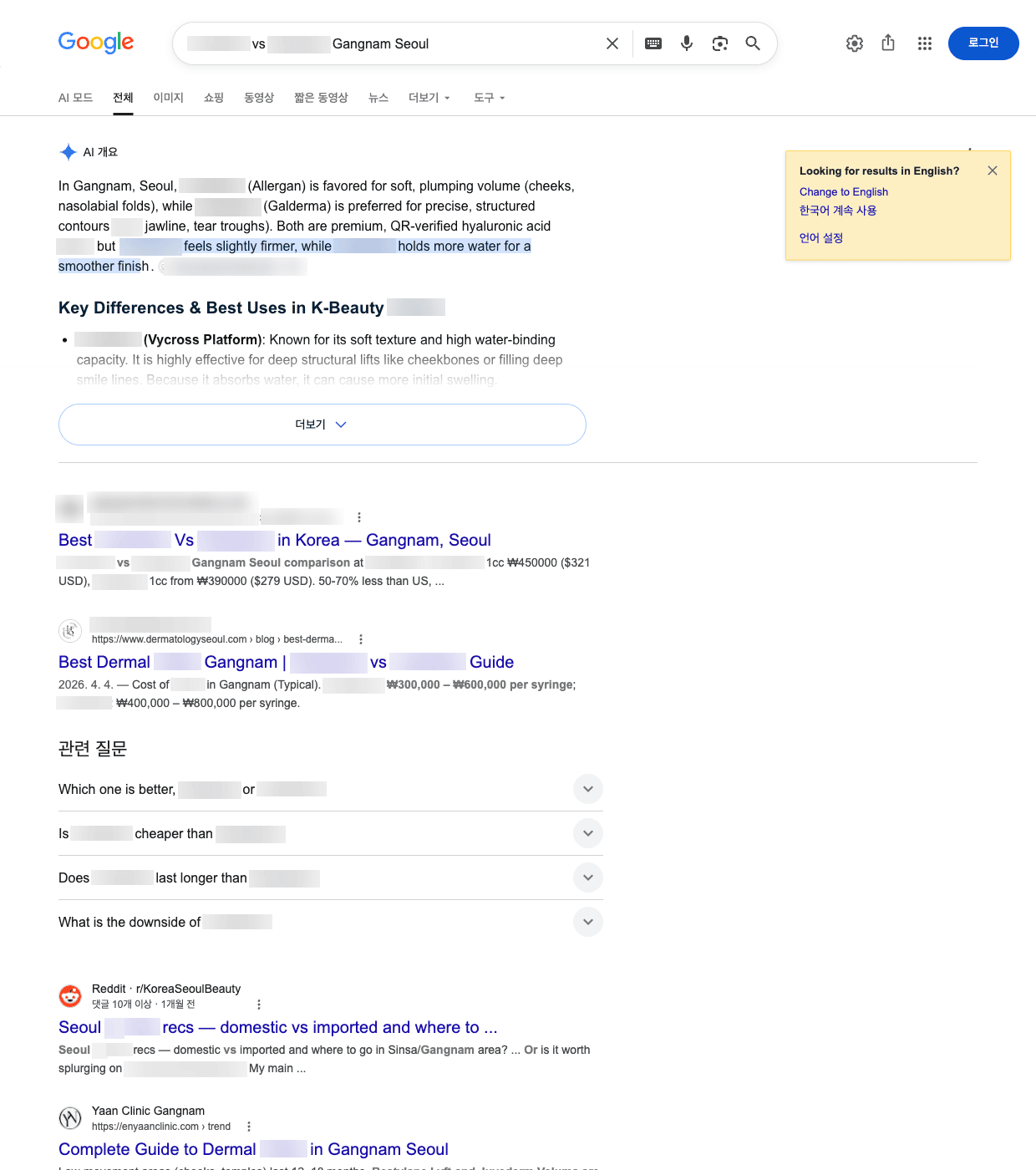
Picture the query: "best skin clinic near me for melasma treatment" — typed into ChatGPT, spoken to Gemini, or triggering an AI Overview on Google. The engine does not consult a stored league table of clinics. It runs retrieval: live searches against a web index, a shortlist of pages pulled back, and an answer composed from what those pages say — usually with citations pointing at the pages it leaned on.
That single fact reframes the whole problem. Being recommended by AI is not about persuading a model; it is about ensuring that when the retrieval step runs for your patients' questions, pages describing your clinic — accurately, credibly, in the asker's language — come back in the shortlist and survive into the answer. Gartner's much-cited forecast that traditional search volume falls 25% by 2026 describes exactly this shift: the question moves from "where do I rank?" to "am I in the answer?"
The rest of this page walks the five layers that decide it. One boundary note to keep this guide honest: if your practice is already invisible in AI answers and you want to know why, start with our diagnostic guide at why your practice isn't showing in AI search; if you are comparing who should fix it, the criteria live in healthcare AEO agency. This page is the underlying mechanism both of those assume.
Layer 1 — Retrievable content: pages the engine can lift an answer from
Engines cite pages they can extract from. That sounds obvious until you audit a typical clinic website: a homepage of adjectives, a services list with no prices or process, and nothing that answers the questions patients actually type. An engine looking for "how much does X cost and what is recovery like" has nothing to lift — so it lifts from whoever wrote it down.
What survives retrieval, in our tracking across four engines, looks consistently like this: one page per real question, the direct answer in the first screen, evidence and numbers rather than superlatives, and clean heading structure an algorithm can parse without guessing. Volume matters too — not padding, but coverage: every treatment, every concern, every "is it worth it / does it hurt / how long" variant is a separate retrieval opportunity. This is the logic our 7,700+ page operation is built on, and it is why coverage-thin sites lose AI answers to content-rich ones even when the thin site has the stronger brand.
A useful self-test before any audit: take the ten questions your front desk answers most often, ask each engine, and see whose pages the answers cite. Those citations are the competitor set that matters now.
Layer 2 — The entity record: your Google Business Profile and everything that must agree with it
Before an engine repeats a claim about a clinic, it tries to resolve the clinic as an entity: does this practice exist, where is it, what does it do, how is it rated? The most machine-trusted anchor for that is the Google Business Profile — verified location, category, hours, reviews, and a website link that ties the profile to a domain.
The failure mode is not a missing profile; it is disagreement. A clinic name spelled three ways, an old address on a directory, a website that never states the practice's legal name, categories that contradict the services pages — each inconsistency makes the entity harder to resolve, and engines respond to ambiguity by leaving the clinic out. Recommending a business is reputational risk for the engine; ambiguous entities are the first ones cut.
The work here is unglamorous and decisive: one canonical name-address-category set, enforced across profile, website, schema, and every third-party listing. In our engagements this is audit item one, because nothing built on top of a broken entity record compounds.
Layer 3 — Structured data: making every page cheap to trust
Schema markup is the machine-readable layer under a page: this is a medical service, this is an FAQ with these nine questions, this article was published on this date by this organization. None of it is visible to patients; all of it lowers the cost, for an engine, of understanding and quoting the page correctly.
Structured data does not purchase citations — anyone selling it as a trick is overclaiming. What we observe in daily tracking is narrower and more useful: pages with clean FAQ, service, and breadcrumb markup get extracted more reliably and misquoted less than equivalent unmarked pages. When an answer engine can read a question-answer pair as data instead of inferring it from prose, your sentence is what appears in the answer — not a paraphrase of it.
Every page we ship carries the full markup set as a build step, not an optimization pass: service or article schema, FAQ schema matched one-to-one with visible questions, and breadcrumbs. The page you are reading is built exactly that way — view source; the methodology is the product.
Layer 4 — Corroboration and E-E-A-T: why your own website is only half the signal
Here is the layer clinic owners most often underweight. Your website supplies claims; third parties supply permission to repeat them. An engine deciding whether to name your clinic looks for corroboration — press coverage, professional directories, community discussion, consistent reviews — because repeating an uncorroborated claim is exactly how an answer engine embarrasses itself.
This is E-E-A-T — experience, expertise, authoritativeness, trust — operating at the entity level, and it maps to concrete work: real author identities with credentials on medical content, sources cited for every factual claim, coverage earned on domains the engines already trust, and profiles that agree with each other. In regulated markets it must be done inside the advertising rules — AHPRA's 2025 guidelines in Australia, GMC and ASA/CAP standards in the UK, FTC endorsement rules in the US — which is a constraint we treat as a feature: compliant corroboration is the only kind that survives scrutiny.
| Layer | What the engine is asking | What the work looks like |
|---|---|---|
| Retrievable content | Is there a page that answers this question? | One page per patient question; direct answers; evidence over adjectives |
| Entity record | Is this clinic real, and is the data consistent? | Google Business Profile + one canonical name-address-category set everywhere |
| Structured data | Can I read this page as data? | Service/Article + FAQ + breadcrumb schema on every page, matched to visible content |
| Corroboration (E-E-A-T) | Does anyone else vouch for this? | Press, directories, professional profiles, reviews — compliant per market |
| Language coverage | Do sources exist in the asker's language? | Native-language asset sets per language line — not homepage translations |
Layer 5 — Language: every language is a separate competition
Retrieval runs over sources in the language of the question. A patient asking in Spanish is answered from Spanish-language pages; a patient asking in Chinese, from Chinese ones. If your clinic exists only in English, you are simply absent from those answers — no matter how authoritative your English presence is.
For most Western clinics this is the widest open flank and the fastest win, because local competitors have not built native-language coverage either: 68 million Spanish speakers in the US, large Chinese-speaking communities in Sydney and Melbourne, Gulf patients researching London clinics in Arabic. Native-language asset sets — real pages answering real questions, not machine-translated homepages — put a clinic into answer sets that are, today, nearly empty of competition. That is the model we run in five languages and the subject of its own guide: multilingual patient acquisition.
What this means for your clinic — and what to do with it
The mechanism has three practical consequences. First, nobody can buy their way in. No engine sells placement inside organic answers — there is no bid that beats a better-corroborated competitor. Positions are earned through the five layers above, which also means they are defensible once won: a competitor cannot simply outspend you back out of the answer.
Second, the channels converge. Everything above — retrievable content, entity hygiene, markup, corroboration — is also what wins classic Google rankings. Built once, correctly, the same asset base compounds in both channels; our full playbook for clinics is at AI search optimization for clinics, and the market data behind the shift is collected in AI search statistics for healthcare.
Third, it is measurable, so it can be priced on results. Because citations and revenue can be tracked daily, we do not need to sell hours: our fee is $0 upfront — 20% of revenue from the patient lines you assign to us, CRM-verified, no per-patient counting, with the exact base designed around your practice during the free audit. Four terms always travel with the 20%: $0 upfront · non-exclusive · cancel anytime · monthly CRM settlement. If the methodology on this page does not produce revenue you can see in your own CRM, we do not get paid — that is the incentive design, in one sentence.
Does the methodology hold up in a real market?
Seoul is where we run it at full scale — the world's most competitive medical tourism market, 2.01 million international patients a year by the health ministry's 2025 count, fought over in five languages simultaneously. The five layers above are not a framework we wrote for this page; they are the operating system behind every number below.
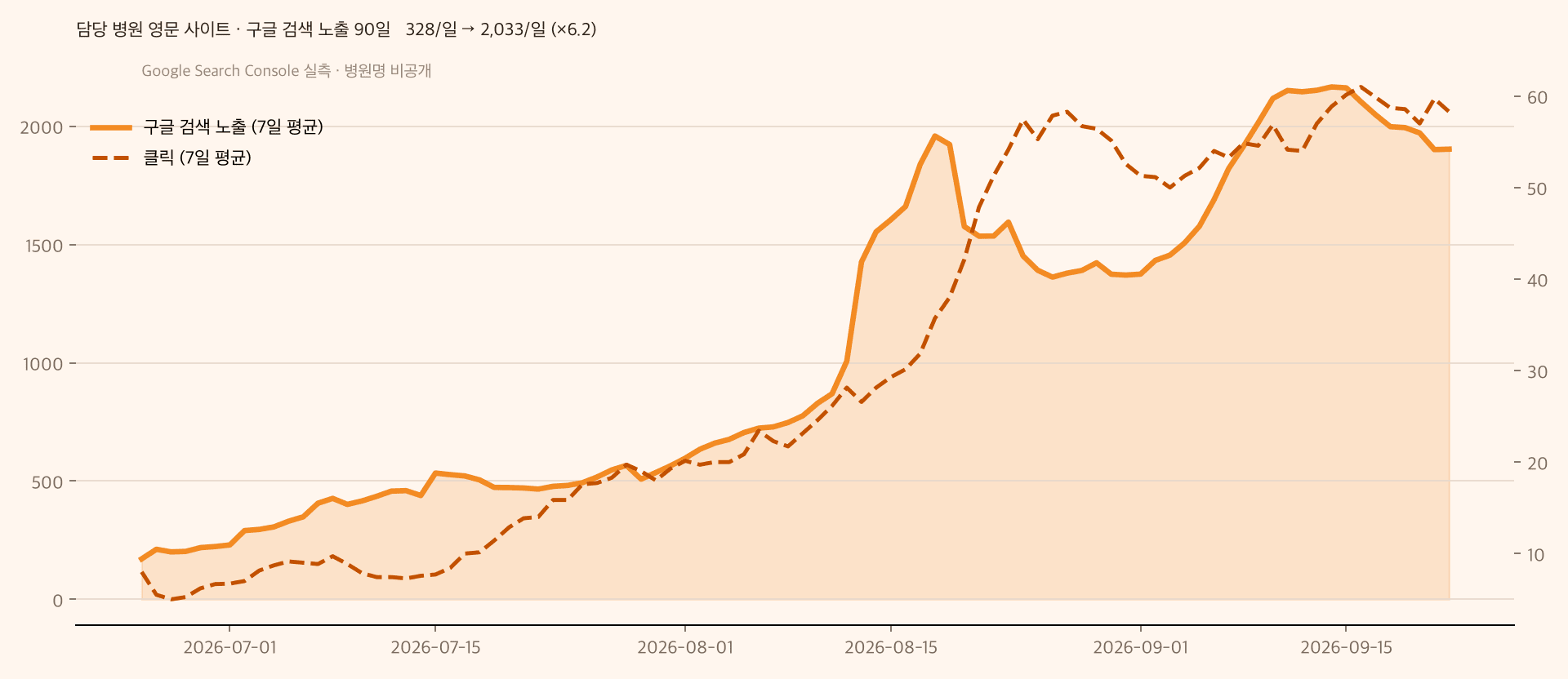
*Basis: internal CRM data from two Seoul dermatology clinics — foreign-patient revenue in the language lines we managed, versus the prior 12-month baseline; individual results vary with specialty, location, and competition. Clinic names withheld under NDA — full-screen walkthrough of live dashboards on the call, reference call available under NDA.
'/%3E%3C/svg%3E)