
What changed on 2 September 2025?
AHPRA and the National Boards brought new cosmetic-procedure advertising guidelines into force, and they reach further than most practices realise. The testimonial prohibition is now explicit about digital behaviour: a clinic that likes, shares, or links to a patient review of its clinical care is treated as using a testimonial in advertising. Influencer testimonials are banned. Higher-risk non-surgical cosmetic procedures carry their own additional advertising restrictions, and no cosmetic-procedure advertising may target people under 18.
The enforcement numbers moved from abstract to concrete: unlawful advertising exposes an individual to fines of up to AUD 60,000 and a body corporate to AUD 120,000. And a point many owners miss — the responsibility for advertising published under your name is yours. It does not transfer to the agency that wrote it. If your current marketing partner learned its playbook on review widgets, influencer posts, and transformation reels, every one of those deliverables is now a liability you carry.
Before-and-after images survive in a narrower form — conditionally permitted, non-misleading, with consent, and restricted for higher-risk procedures. But a growth plan that leans on them is a plan that leans on the most scrutinised square metre of Australian health advertising.
Why compliant clinics will out-market non-compliant ones
Here is the part that gets missed in the panic: the guidelines closed channels that AI search never rewarded in the first place. ChatGPT, Gemini, Perplexity, and Google's AI Overviews do not cite a clinic because an influencer tagged it or because its homepage carousel rotates five-star quotes. They cite pages that answer patient questions in plain, verifiable, well-structured language, with sources a machine can check. That is not a workaround for the 2025 guidelines — it is a description of them.
So the practices that rebuild their visibility on answer-grade content get two returns on one investment: a marketing engine regulators have no quarrel with, and the exact material AI engines prefer to cite. Meanwhile competitors who keep tiptoeing around the testimonial ban are spending their budget defending channels in decline — Gartner projects traditional search volume to fall 25% by 2026 as answer engines absorb the query.
| Channel the 2025 guidelines restrict | Risk it now carries | Compliant engine that replaces it |
|---|---|---|
| Patient testimonials & review reposting | Banned for clinical care — liking/sharing/linking included | Factual answer pages that AI engines cite by name |
| Influencer promotion | Banned as testimonial advertising | Third-party citations earned by content, not paid to creators |
| Before-and-after showcases | Conditional; restricted for higher-risk procedures | Procedure-mechanics and decision-guide pages, schema-marked |
| Outcome and results claims | Prohibited — fines to AUD 120,000 | Credentials, process, and sources — verifiable, no promises |
| English-only local ads | Not a breach — just leaves whole communities unserved | Chinese-language lines for Sydney & Melbourne, same rules applied |
One caution in the other direction: compliance alone is not a strategy either. A compliant page nobody finds changes nothing. The work is building compliant pages that win the citation — which is a measurable, trackable output. We measure it daily, across four AI engines, and show you the tracker before you sign anything.
What does the growth play look like for an Australian clinic?
Australia's inbound medical-travel market is the smallest of the three Western markets we operate in — roughly USD 445 million in 2025 — so we will not pretend overseas patients are the premise. The premise is domestic, and the upside is specific:
1 · Domestic AI-search visibility, compliant by design
- Patients in Sydney, Melbourne, and Brisbane already ask ChatGPT and Google's AI Overviews which clinic to book — the citation goes to whoever published the best answer
- Every page drafted to the 2025 guidelines from the first line: no testimonials, no outcome claims, no promises of results
- You review and approve before publication — because the professional responsibility is yours, we build to it
2 · Sydney & Melbourne's Chinese-speaking communities
- Large, established communities researching healthcare in their own language — and mostly unserved by clinic websites written only in English
- We build and run Traditional and Simplified Chinese lines with the same methodology behind our 7,700+ operated pages, AHPRA rules applied throughout
- Inquiries answered 24/7 on the messengers those communities actually use — see multilingual patient acquisition
3 · IVF inbound — the one genuine overseas line
- Fertility care is Australia's strongest real inbound segment for private clinics, drawing patients from Southeast Asia and Chinese-speaking markets
- Multilingual treatment-decision content plus 24/7 response converts research-stage patients before they shortlist elsewhere
- Full segment breakdown: IVF clinic marketing
Where does that leave cosmetic-surgery inbound? Honestly: as a footnote. Australians flying to Thailand or Turkey for procedures is the bigger flow, which makes trust-led domestic visibility — being the clinic AI names when a patient asks who is qualified and what the procedure involves — the more defensible position than chasing arrivals. If you want the segment-by-segment logic across all three markets, start with the honest playbook on attracting international patients.
What does AHPRA-compliant marketing cost?
The whole pricing model fits in one paragraph, because pricing you must book a call to see is its own red flag. $0 upfront — our fee is 20% of revenue from the patient lines you assign to us, CRM-verified, with no per-patient counting. Typical healthcare marketing retainers run $3,000–8,000 (USD) a month whether results arrive or not; we charge nothing until revenue is sitting in your CRM. Content production, domains, hosting, rank and AI-citation tracking, and the 24/7 multilingual response line are funded by us.
The exact base is designed around your practice during the free audit, before anything is signed: which lines you assign (domestic, international, or both), what counts as new revenue, and what is excluded automatically — existing patients, channels you run yourself, lines we don't manage. Four terms always travel with the 20%: $0 upfront · non-exclusive · cancel anytime · monthly CRM settlement.
And the legal line, stated plainly because Australian practitioners are right to ask: this is not a payment for sending patients. We never count, steer, or broker individual patients — the 20% is a flat marketing-services rate on a revenue pool we are responsible for growing, settled against your own CRM. Have your lawyer review the agreement; we expect it. The full mechanics are on the performance-based healthcare marketing page.
| Term | How it works for an Australian practice |
|---|---|
| Rate | 20% flat on the assigned lines — the rate never moves with volume |
| Base | Collected revenue from the patient lines you assign — designed together during the free audit |
| Verification | Your CRM — one monthly export, no per-patient counting |
| Upfront cost | $0 — no retainer, no setup fee; production and tracking funded by us |
| Invoicing | Monthly, in AUD, paid by domestic transfer — reverse-charge GST treatment as a non-resident supplier |
| Exit | Non-exclusive · cancel anytime · no termination fee |
Why should an Australian clinic trust a Seoul track record?
Because Seoul is the hardest place on earth to do this job. Korea treated 2.01 million international patients in 2025, and its clinics fight for visibility in five languages simultaneously — under a medical-advertising law that, like AHPRA's framework, restricts testimonials and comparative claims. Ranking and earning AI citations in that market, under those rules, is the credential we bring to yours. Two documented engagements, both Seoul dermatology clinics, measured identically:
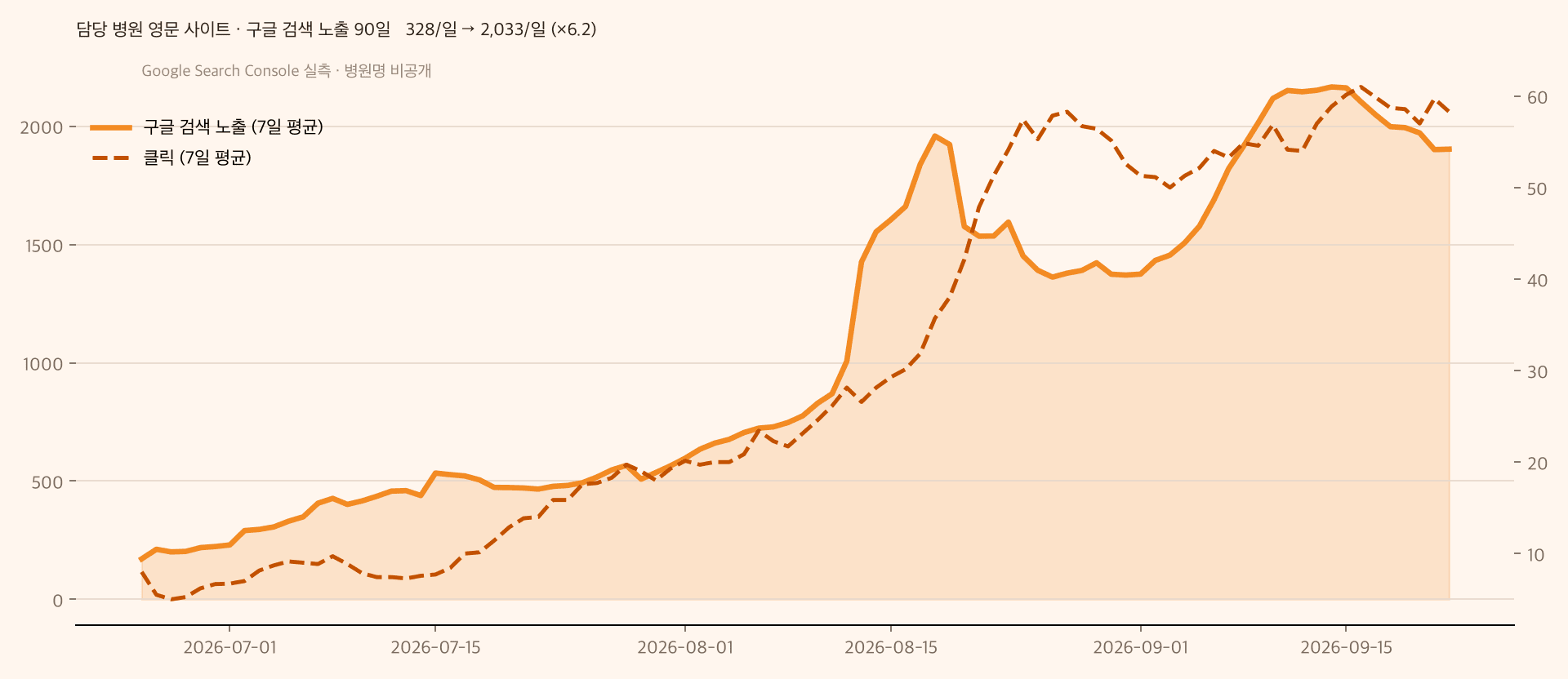
None of this is a promise about your clinic — markets, specialties, and competition differ, and anyone who promises you outcomes is showing you a red flag, not a service. It is evidence that the methodology produces measurable movement, in a market harder than yours, under advertising rules stricter than most. The AI-search mechanics behind it are documented on the healthcare AEO agency page.
How is compliance actually built into the work?
Compliance is not a review stage bolted on at the end — it is the drafting standard. Every page for an Australian client is written under a fixed rule set derived from the 2025 guidelines: no testimonials or review quotations of clinical care, no outcome or results claims, no superlatives about skill or safety, no content aimed at minors, and before-and-after material only where the guidelines permit it and never for higher-risk procedures. Claims of fact carry sources on the page.
Then the accountability loop closes where the law says it must: with you. Nothing publishes until you or your practice manager has approved it, because AHPRA holds the practitioner responsible for advertising regardless of who produced it. You get a compliant asset base and a paper trail showing you reviewed it — which is precisely the position you want to be in if a complaint ever lands.
Ask any agency you are evaluating — including us — three questions: Show me your drafting rules for the 2025 guidelines. Who approves before publication, and is it documented? What happens to my visibility if I stop paying you? Our answers: this section, you with sign-off records, and the content assets keep working — coverage and links built for your clinic stay with your clinic.
'/%3E%3C/svg%3E)