
First, the honest question: does your segment actually have inbound?
The uncomfortable fact behind every "attract international patients" pitch: inbound medical travel to Western countries is dominated by large academic centers with staffed international departments — the complex cardiac, oncology, and orthopedic cases fly to them, not to private practices. US inbound estimates range from roughly 450,000 to 1.9 million patients a year depending on the source, and the spread itself tells you how murky the aggregate numbers are. Planning your clinic's growth on an aggregate is how marketing budgets die.
Segments are where the truth lives. Some private-clinic segments have genuine, documented inbound flow. Others have essentially none — and for them the international opportunity is actually sitting inside the city limits: patients who live locally and search in another language. Here is the verdict table we design audits around:
| Market & segment | Is inbound real? | The honest play |
|---|---|---|
| UK — London self-pay (Harley Street area) | Yes — 100,000+ overseas patients a year treated in London, much of it Gulf-funded | Arabic-language visibility + 24/7 response — see Gulf patients, London |
| US — gateway-city dental & aesthetic (Miami, Houston, LA) | Mixed — cross-border and community demand, not mass inbound | Spanish-first local visibility + win-back — see compete with dental tourism |
| AU — IVF & fertility | Yes — Southeast Asian and Chinese-speaking inbound is documented | Multilingual decision-stage content — see IVF clinic marketing |
| AU — cosmetic & dermatology | Thin — outbound to Thailand/Turkey is the bigger flow | Compliant domestic AI visibility — see AHPRA-compliant marketing |
| US/AU — general aesthetic, non-gateway cities | Little to none | Multilingual local communities + AI-search visibility; inbound as upside only |
Notice what this table does to the word "international." For a Miami dentist, the international patient is a Spanish-speaking family four blocks away. For a London consultant, it is a Gulf patient whose government funds treatment abroad. For a Melbourne IVF clinic, it is a couple researching from Jakarta. Three different machines — one discipline underneath.
The five-step playbook
Step 1 — Pick your language lines from evidence, not aspiration. Start with the languages your catchment area already speaks: the US has 68 million Spanish speakers; Sydney and Melbourne hold large Chinese-speaking communities; London's self-pay market reads Arabic. Then add the language of any genuine inbound line your specialty has. This ordering matters because domestic multilingual demand converts first and funds patience for the slower inbound lines.
Step 2 — Build answer-grade pages in those languages. Not translated brochures — native pages that answer the exact questions patients type and ask: what the procedure involves, what recovery looks like, how to verify a practitioner, what to prepare before flying. Structured, sourced, schema-marked. This is the asset the whole model stands on, and it is the difference between content that ranks and content that merely exists.
Step 3 — Win the AI citation, not just the ranking. Gartner projects traditional search volume to drop 25% by 2026 as patients move to answer engines. A patient in Riyadh or Jakarta asking ChatGPT for a shortlist never sees page two of Google — they see three cited names. Getting into that answer is a distinct, measurable discipline — we track it daily across four AI engines, and the audit shows you the tracker live.
Step 4 — Respond where the patient lives, at the hour they write. WhatsApp for Spanish-speaking and Gulf patients, WeChat for Chinese-speaking patients, LINE for Japanese. International inquiries arrive at 3 a.m. your time, and a message unanswered until morning is a booking made elsewhere overnight. A 24/7 multilingual response line is not a luxury tier — it is where the conversion actually happens.
Step 5 — Measure collected revenue, not inquiries. Inquiry counts flatter every vendor and feed attribution disputes. The only number that survives scrutiny is collected revenue in the patient lines the marketing is responsible for, read out of your own CRM — one monthly export, no per-patient counting. If a vendor resists CRM-based measurement, you have learned what you needed to know before signing.
Three traps that burn international marketing budgets
Trap one: buying brokered patients. Medical tourism facilitators hand over individual patients and typically keep 25–30% of each brokered case. Whatever the ethics of counting heads, the structural problem is what you own afterward: nothing. The day the broker stops sending — or raises the cut — the pipeline stops with them. Assets you own compound; volume you rent evaporates. The full category comparison is on our international patient marketing agency guide.
Trap two: vendors who promise outcomes. Promised rankings, promised patient counts, promised revenue — in healthcare marketing these are not confidence, they are the single most reliable warning sign in the industry. Real vendors show live dashboards and let the measurement carry the argument. Our own case figures come with their calculation basis attached, and we expect you to interrogate them.
Trap three: ignoring the advertising rules of your own market. Content that breaches AHPRA's 2025 guidelines in Australia, GMC and ASA/CAP standards in the UK, or FTC endorsement rules in the US doesn't just underperform — it transfers legal risk directly to you, because regulators hold the practitioner responsible for advertising published in their name, whoever wrote it. Compliance has to be a drafting standard, not an afterthought.
Why domestic and international growth are one engine
The pages that make a local patient choose you when they ask Gemini or Google's AI Overview which clinic to book are built with the same discipline as the pages a patient in another country finds: real answers, real evidence, clean structure, verifiable sources. Domain authority, citation history, and review signals compound across both audiences at once — which is why splitting "domestic marketing" and "international marketing" into separate budgets means paying twice for one machine.
So the sequence we design is deliberately unglamorous: domestic patients build the base, international patients add the upside. In the US and Australia, engagements usually start with domestic AI-search visibility and the multilingual communities in the clinic's own city; in the UK, the London inbound market is strong enough to lead. Either way the measurement is identical — collected revenue in your CRM, in the lines assigned to us, settled monthly.
And the commercial terms are built to match that patience: $0 upfront — 20% of revenue from the patient lines you assign, CRM-verified, no per-patient counting, with the exact base designed around your practice during the free audit. Four terms always travel together: $0 upfront · non-exclusive · cancel anytime · monthly CRM settlement. Typical retainers of $3,000–8,000 a month bill you for the waiting; a 20% results rate makes the waiting our problem. One legal note, stated plainly: we never count, steer, or broker individual patients — the 20% is a flat marketing-services rate on a revenue pool, and in the US it covers cash-pay and self-pay services only. Full terms on the performance-based healthcare marketing page.
What does this look like when it works?
Our proving ground is Seoul — a market that treated 2.01 million international patients in 2025 and fights for them in five languages at once. If the playbook above holds anywhere, it has to hold there first. Two documented engagements, both dermatology clinics, measured the same way:
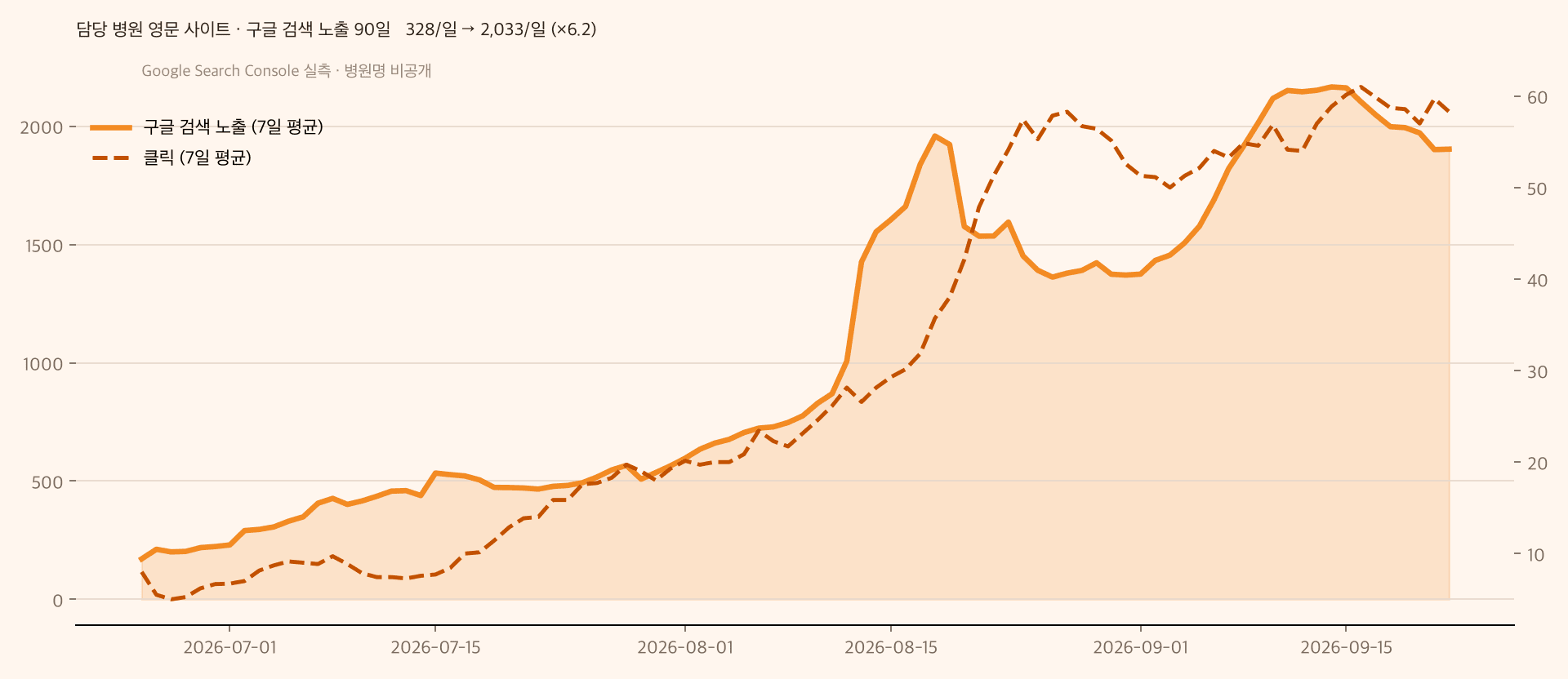
Every figure above comes with its basis attached because that is the standard we would tell you to demand from anyone. The free audit applies the same standard to your clinic: where you show up today, in which languages, in which engines — and an honest read on whether your segment's inbound is worth chasing at all.
'/%3E%3C/svg%3E)