What is dental SEO — and what do dental SEO services actually include?
Dental SEO is the work of making your practice the one patients find when they look for a dentist nearby or for a specific treatment — in the Google map pack, in organic results, and now inside AI-generated answers. Good dental SEO services are less about tricks than about completeness: every signal a search engine uses to choose which practice to show is present, consistent, and stronger than the practice two streets away.
That is also the honest answer to anyone searching “SEO dentist” or comparing SEO services for dentists: most proposals describe the same deliverables in different words. Stripped back, there are five working parts, and an honest provider can tell you how each one is checked:
| Part | What it does for the practice | How you can check it |
|---|---|---|
| Local search (map pack) | Puts you in the top three map results for “dentist near me” and “[town] dentist” | Map positions measured from several points around your catchment, not only from the front desk |
| Google Business Profile | The listing most local searches resolve to — categories, services, hours, photos, booking link | Correct primary category, every treatment listed as a service, name-address-phone identical everywhere |
| Treatment pages | One substantial page per service: implants, clear aligners, veneers, emergency care, children's dentistry | Each page ranks for its own treatment + town query |
| Reviews | Fresh, genuine patient reviews that search engines and patients both weigh | A steady monthly flow, a reply to each one, no filtering of who gets asked |
| Technical SEO | Speed, mobile layout, crawlable structure, Dentist schema markup | Core Web Vitals, index coverage in Search Console, valid structured data |
Notice what is not on that list: ad management, social posting, and “four blog posts a month” with no target query behind them. Those can have a place, but they are not dental website SEO. When a proposal is mostly made of them, you are paying for activity under an SEO label — dental SEO marketing in name, not in what it moves.
How does each part of dental SEO win patients?
Why does the map pack decide most local dental searches?
For a search like “emergency dentist open now,” the map results and the Business Profile usually sit above every organic link. Google weighs proximity, which you cannot change, against relevance and prominence, which you can: the right primary category, services worded the way patients type them, matching practice details across directories, and a review profile that looks alive. That is why SEO for dental clinics starts with the listing, not with the blog.
What should a dental Google Business Profile contain?
Every treatment you want to be found for, entered as a service; accurate hours, including any emergency availability; real photos of the rooms and the team; a booking link; and a website field that lands on a page built to turn a visit into an appointment. The profile itself should belong to the practice, held in your own account. An agency that keeps primary ownership of your listing holds the most valuable local asset you have.
Why do treatment pages matter more than the homepage?
Once patients know what they need, they stop searching for “dentist” and start searching for the treatment — implants, aligners, a cracked tooth, sedation for nervous patients — usually with a town or neighborhood attached. A dental office SEO program — or SEO for a dental practice of any size — builds one solid page per treatment that answers what that patient actually wants to know: what happens at each visit, how long it takes, a realistic price range, what recovery feels like, and who is a poor candidate. A paragraph and a phone number neither ranks nor gets quoted.
How do reviews affect dental SEO?
Reviews feed both the ranking and the decision. What counts is a steady stream of genuine reviews and a reply to each one, not a burst after a campaign. Two cautions. Never choose which patients get asked — filtering out unhappy ones breaks Google's review policies. And check your country's rules before featuring reviews on your own pages: in Australia, AHPRA restricts testimonials about clinical aspects, sharing them included. Reviews belong in your intake process, run by your team; no agency should write, buy, or filter them.
What counts as technical SEO for a dental website?
The plumbing: pages that load quickly on a phone, a structure search engines can crawl, HTTPS, no near-duplicate pages competing with each other, and structured data — Dentist or LocalBusiness schema for the practice, FAQPage on question blocks, consistent entity details on every page. It rarely wins a patient on its own, but a slow or broken site quietly cancels out the other four parts.
Why does dental SEO now have to include ChatGPT, Gemini, and AI Overviews?
Because a growing share of patients never reach the results page. They ask an assistant “who is a good implant dentist near me, and roughly what does it cost?” and act on the single answer they get; Gartner's widely quoted projection has traditional search engine volume falling 25% by 2026 as the habit spreads. That answer is assembled from the same raw material as classic dental SEO — your Business Profile, treatment pages, reviews, third-party listings — but the engine is choosing sentences to repeat, not links to rank.
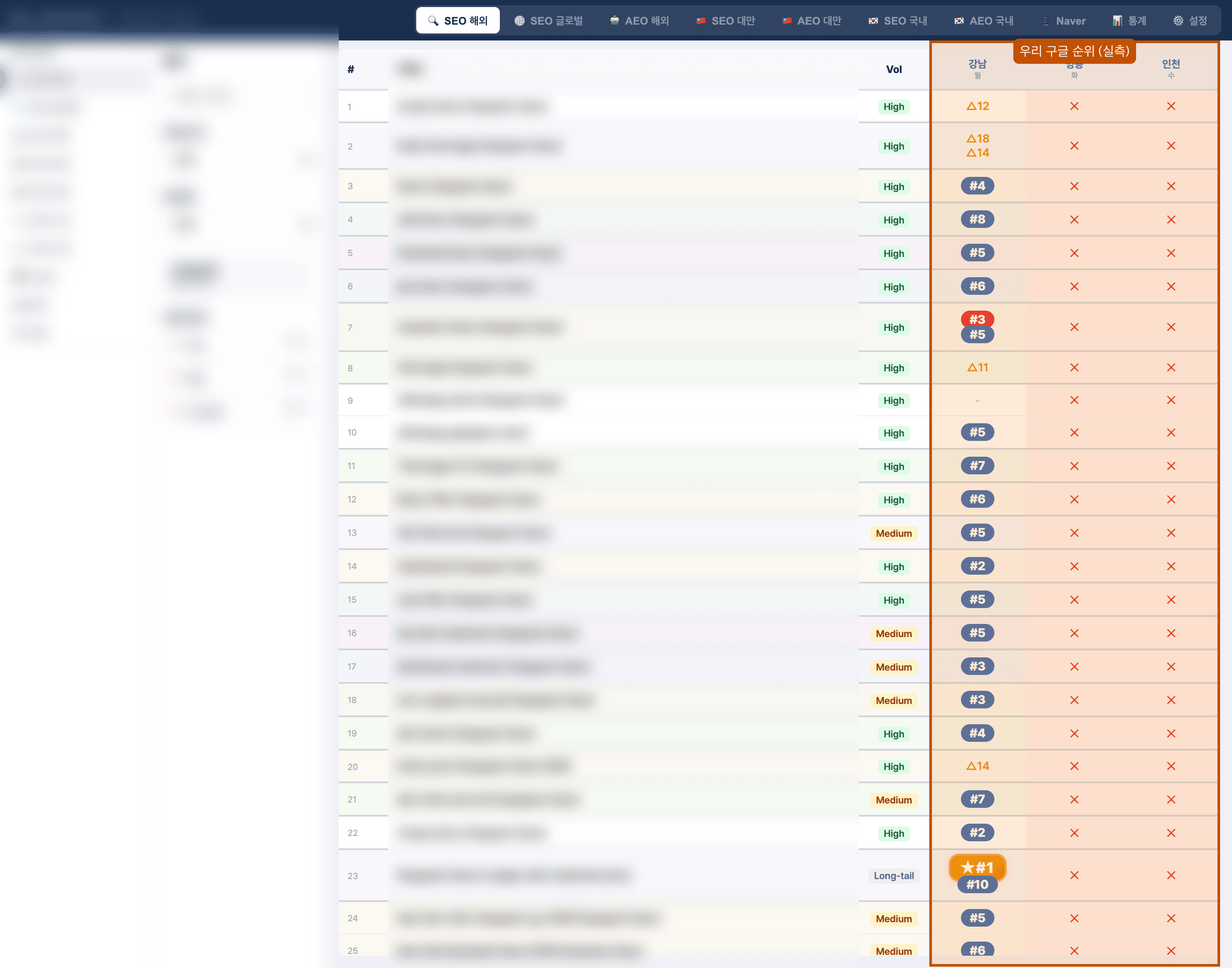
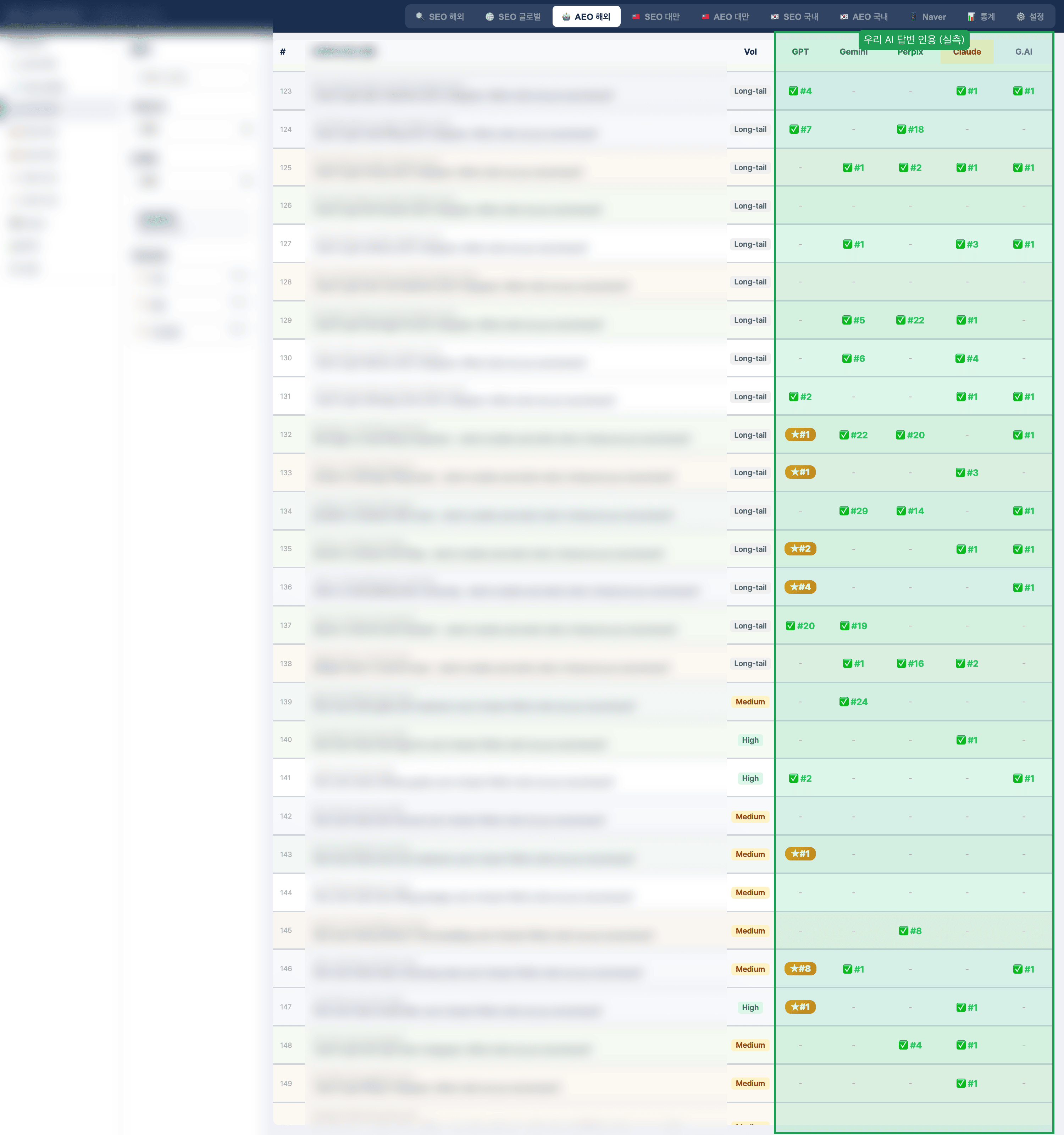
Three things change in practice. Treatment pages need a direct answer in their first lines, because that is the part that gets quoted. Practice details need to match everywhere, because engines cross-check you as an entity before naming you. And measurement has to cover the answers themselves: a rank tracker can show you on page one while Gemini recommends a competitor. We measure both sides every day — Google positions across 2,050 tracked keywords and citation checks across four AI engines. The screens below are the actual instruments.
The full working method behind AI citations is laid out in AI search optimization for clinics; if you are comparing vendors in that category specifically, start with what a healthcare AEO agency does.
Who should dental SEO reach — local patients, or patients from further away?
Local patients first. For a dental practice, SEO is above all a domestic play: the people searching and asking AI about implants or a same-day appointment are overwhelmingly within driving distance, and that local flow is the base every engagement is built on. If the base is not working, nothing layered on top will.
The upside runs on the same pages. Around 68 million Latinos live in the US, many of whom search in Spanish; Sydney and Melbourne have large Chinese-speaking communities; London treats more than 100,000 overseas patients a year. A practice whose treatment pages exist natively in the languages around it appears in answers that an English-only competitor never enters — and the same multilingual pages are what patients researching from abroad find.
There is a defensive side as well. About 850,000 Americans were expected to travel abroad for dental work in 2025, most of them comparing price. Pages that answer the lifetime-cost and aftercare questions those patients research keep part of that flow at home. Both lines have their own guides — Spanish SEO for dentists and competing with dental tourism — so this page stays on the core program.
Dental SEO in the US, UK, and Australia: what changes?
The five parts are the same in every market. What changes is what your pages, reviews, and claims are allowed to say — and the professional responsibility for that stays with the practice, not the agency. Every page we write follows the rules of your market, and you approve it before it goes live.
US — FTC rules and fee structure
- Performance claims must reflect what patients can typically expect; a “results not typical” line does not cure a misleading claim (FTC Endorsement Guides, 2023 revision)
- Agencies that produce misleading content share the liability — one more reason to keep every claim specific and sourced
- Our fee covers cash-pay and self-pay dentistry only, with federal-program business excluded; stricter states (FL, NY, CA) can choose a flat-tier alternative
UK — GDC registration, ASA/CAP advertising
- Dental search engine optimisation (optimization, in US spelling) produces advertising: ASA/CAP guidance expects testimonials to be genuine and representative, and rules out promised outcomes
- Cosmetic treatments carry extra limits — no time-limited offers, nothing aimed at under-18s, nothing that trivialises treatment
- Registered professionals keep responsibility for what appears under their name, so pages are written to that standard and signed off by you
AU — AHPRA-compliant by default
- Testimonials about clinical aspects cannot be used in advertising — liking, sharing, or linking to them included
- AHPRA's guidelines for cosmetic procedures, in force from 2 September 2025, add rules for higher-risk non-surgical treatments and ban advertising aimed at under-18s
- Penalties reach AUD 60,000 for individuals and AUD 120,000 for bodies corporate — our Australian pages carry no testimonials and no outcome claims
What do dental SEO services cost — a retainer, or 30% of results?
Published benchmarks put standalone dental SEO at $750–5,000 a month, with most single-location practices paying $1,000–2,500. Programs that add paid search and social run $3,000–8,000 for one location and $10,000–25,000 for multi-location groups. Ad spend sits on top, and dental clicks are among the most expensive in search at roughly $7.85 each on average. Every one of those fees falls due in a slow month too.
Our model removes the fixed line. $0 upfront — our fee is 30% of collected revenue from the patient lines you assign to us, CRM-verified, with no per-patient counting. We fund the treatment pages, hosting, tracking, and the 24/7 multilingual response line; you pay when revenue appears in your practice-management system or CRM, and not before. The exact base is designed around your practice during the free audit — which lines you assign and what is excluded are agreed case by case, typically leaving out existing patients and channels you run yourself.
| Line item | Typical dental SEO retainer | HEIM GLOBAL |
|---|---|---|
| Monthly fee | $750–5,000 for SEO alone; $3,000–8,000 for full digital | $0 — 30% of revenue from the lines you assign |
| A month with no new revenue | Same invoice | The invoice falls with the revenue |
| Treatment pages | Often a quota of posts | One page per treatment and patient question, in each language you serve |
| Google Business Profile | Sometimes held in an agency account | Stays in your account |
| AI-search measurement | Rarely included, or sold as an add-on | Daily citation checks across four AI engines |
| Attribution | Agency report or call-tracking numbers | One monthly export from your own CRM |
| Contract | Often a 12-month term | Non-exclusive |
One point worth stating plainly, because dental owners have good reason to ask: this is not a payment for each patient. Pay-per-lead vendors earned a poor reputation in dentistry by billing no-show leads and routing existing patients' calls through their own tracking numbers. We never count, steer, or broker individual patients — the 30% is a flat marketing-services rate on a revenue pool, settled from your records. Three terms travel with it every time: $0 upfront · non-exclusive · monthly CRM settlement. Have your healthcare attorney read the agreement; we expect it. Wider agency pricing is broken down in healthcare marketing agency cost, and the way out of an existing contract in no-retainer marketing agency.
Is there evidence the method works?
Our record comes from Seoul, where clinic marketing runs in five languages at once and two million international patients arrive each year. Two dermatology clinics there grew foreign-patient revenue in the language lines we managed by +200% and +186%.1 They are not dental practices, and we say so: the evidence is for the method — treatment-level pages, consistent entity data, daily measurement of rankings and AI answers — which is the same method a dental program runs on.
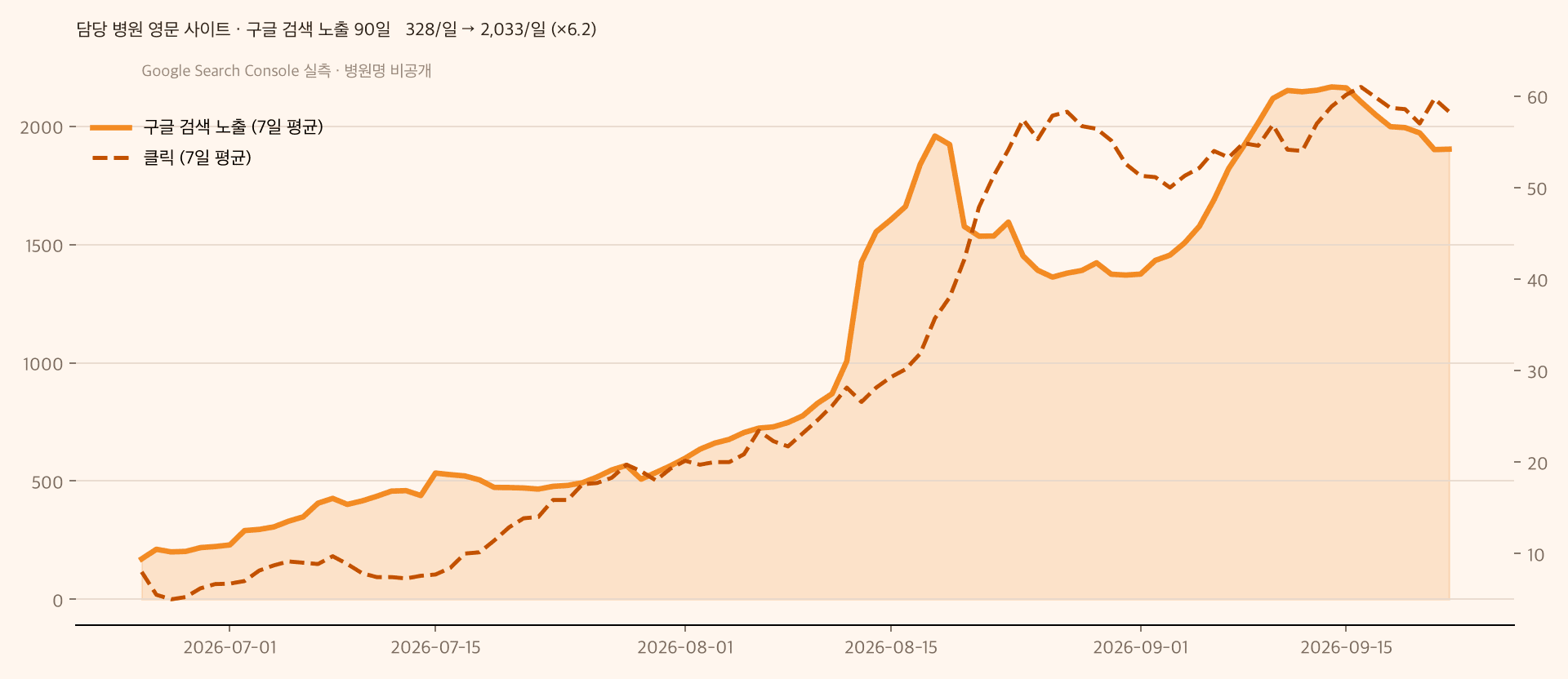
1 Internal CRM data, two Seoul dermatology clinics — foreign-patient revenue in assigned language lines versus the prior baseline; individual results vary with specialty, location, and competition. Clinic names withheld under NDA; a full-screen walkthrough of the live dashboards is available on the call.
What are the red flags in a dental SEO proposal?
Whoever you hire, six patterns in a proposal deserve a hard question before you sign. Page one by a date. Nobody controls rankings or AI answers; a dated promise means the proposal is selling confidence, not work. Your listing or domain in their account. The Business Profile and the domain should be registered to the practice from day one. Tracking numbers swapped onto your listings with no plan for when you leave — they also break the name-address-phone consistency that local rankings depend on.
Dozens of near-identical suburb pages — “dentist in [suburb]” with the same text and a new place name. Google treats them as doorway pages. Reviews written, bought, or filtered by the vendor. And reports full of activity — posts published, hours logged — with no rankings, no AI citations, and no revenue line. If two or more of these appear, ask for changes first.
Our answers to each are on this page. The free AI-visibility audit shows where your practice stands today across Google, ChatGPT, and Gemini — free, no obligation.
How does a dental SEO engagement start?
With the audit: map positions from several points around the practice, a Business Profile review, a list of missing treatment pages, and what four AI engines say when asked about your treatments in your town. If the market has room, we agree which patient lines you assign and what the base leaves out, then build. Launch takes about 30 days from the audit; rankings usually begin to move within weeks and settle over several months, depending on how crowded your area is. From the first day you see the same dashboards we do, and if the work does not produce revenue in your CRM, the 30% of nothing is nothing.
'/%3E%3C/svg%3E)